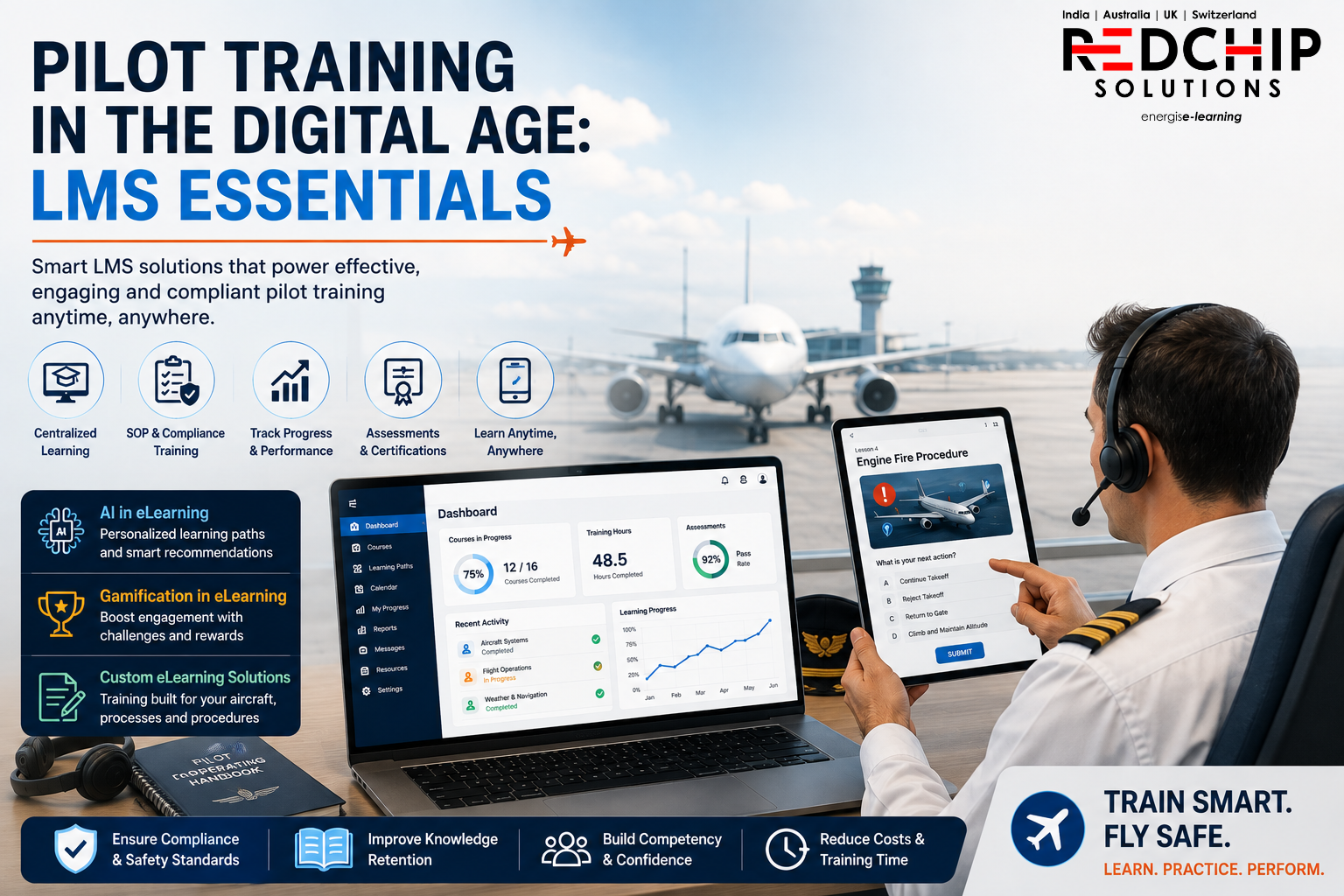


AI-driven learning analytics in airline academies is changing how aviation training programs measure progress, improve performance, and maintain safety standards. Airline academies handle complex training needs, strict regulations, and diverse learner groups. Because of this, traditional reporting and manual assessments are no longer enough.
Today, AI in eLearning helps airline academies move from basic tracking to deep insight. By using data intelligently, academies can understand learner behavior, predict skill gaps, and improve training outcomes. To make this shift effective, many organizations rely on custom eLearning solutions that align analytics, content, and learning design on a single eLearning platform.
Request a demo to understand how data-driven insights can strengthen your airline academy’s training programs.
What You’ll Discover in This Blog
In the sections ahead, we cover:
- Why AI-driven learning analytics matters in airline academies
- How the eLearning design process supports data-led training
- The role of microlearning modules and engagement data
- How gamification in eLearning improves insight and retention
- Why eLearning content development and providers matter
- How platforms turn analytics into action
To see how these solutions are applied in real training environments, visit: Red Chip Solutions portfolio
Why AI-Driven Learning Analytics in Airline Academies Matters
AI-driven learning analytics in airline academies helps training leaders move beyond completion rates. Instead of asking who finished, they can ask who is ready.
By analyzing assessment scores, simulator performance, and learning patterns, AI highlights risk areas early. As a result, instructors intervene before small gaps become safety issues. This proactive approach improves outcomes across pilot, cabin crew, and ground staff training.
According to IATA, data-driven training plays a key role in improving aviation safety and operational readiness.
AI-Driven Learning Analytics and the eLearning Design Process
The eLearning design process becomes more effective when paired with AI-driven learning analytics in airline academies. Design decisions are no longer based on assumptions. Instead, they rely on real learner data.
First, learning goals align with operational roles. Then, analytics show where learners struggle or disengage. Consequently, designers refine content, assessments, and flow. This cycle ensures training remains relevant and effective over time.
Microlearning Modules Powered by Learning Analytics
AI-driven learning analytics in airline academies works especially well with microlearning modules. Short lessons generate clearer data signals than long courses.
For example, if learners repeatedly fail a short safety module, the issue becomes visible quickly. As a result, instructors adjust content or add reinforcement. Moreover, microlearning fits aviation schedules, making data collection more consistent.
Gamification in eLearning and Data Visibility
Gamification in eLearning enhances AI-driven learning analytics in airline academies by increasing engagement. When learners interact more, analytics become richer and more accurate.
The benefits of gamification in corporate learning include higher participation and better recall. From a data perspective, gamified elements reveal motivation levels, response speed, and confidence gaps. Therefore, academies gain both engagement and insight without compromising seriousness.
AI in eLearning for Smarter Airline Training Decisions
AI in eLearning turns raw data into actionable insight. Within AI-driven learning analytics in airline academies, AI identifies trends that humans might miss.
For instance, AI can predict which learners need extra simulator time or refresher training. Consequently, resources are allocated more efficiently. Over time, this improves training quality while reducing unnecessary costs.
eLearning Content Development Guided by Analytics
AI-driven learning analytics in airline academies also improves eLearning content development. Content teams see which modules perform well and which do not.
Because of this visibility, updates become targeted instead of reactive. Learning stays aligned with real performance needs rather than outdated assumptions. This data-led approach supports continuous improvement across programs.
The Role of eLearning Content Providers in Analytics-Driven Training
Experienced eLearning content providers understand how to design content that works with analytics systems. In AI-driven learning analytics in airline academies, this expertise matters.
When providers align content structure with data collection needs, insights become clearer. Learners benefit from better-designed courses, while academies gain meaningful reporting.
The International Civil Aviation Organization (ICAO) also emphasizes data-supported training systems for aviation safety and compliance.
Choosing the Right eLearning Platform for Airline Academies
A strong eLearning platform is essential for AI-driven learning analytics in airline academies. The platform must support dashboards, reporting, personalization, and integration with simulators or assessments.
When combined with custom eLearning solutions, the platform becomes a decision-support system. Administrators see trends clearly, instructors act faster, and learners receive timely support.
Conclusion: Turning Data Into Training Impact
AI-driven learning analytics in airline academies transforms how training success is measured and improved. By combining AI in eLearning, microlearning modules, gamification in eLearning, and structured eLearning design processes, academies move from reactive training to proactive readiness.
Supported by reliable eLearning content providers, scalable eLearning platforms, and tailored custom eLearning solutions, airline academies can deliver safer, smarter, and more effective training programs.
If you’re ready to turn learning data into real training impact, now is the time to start. Contact Us and disc over how smarter learning analytics can support the future of your airline academy.