
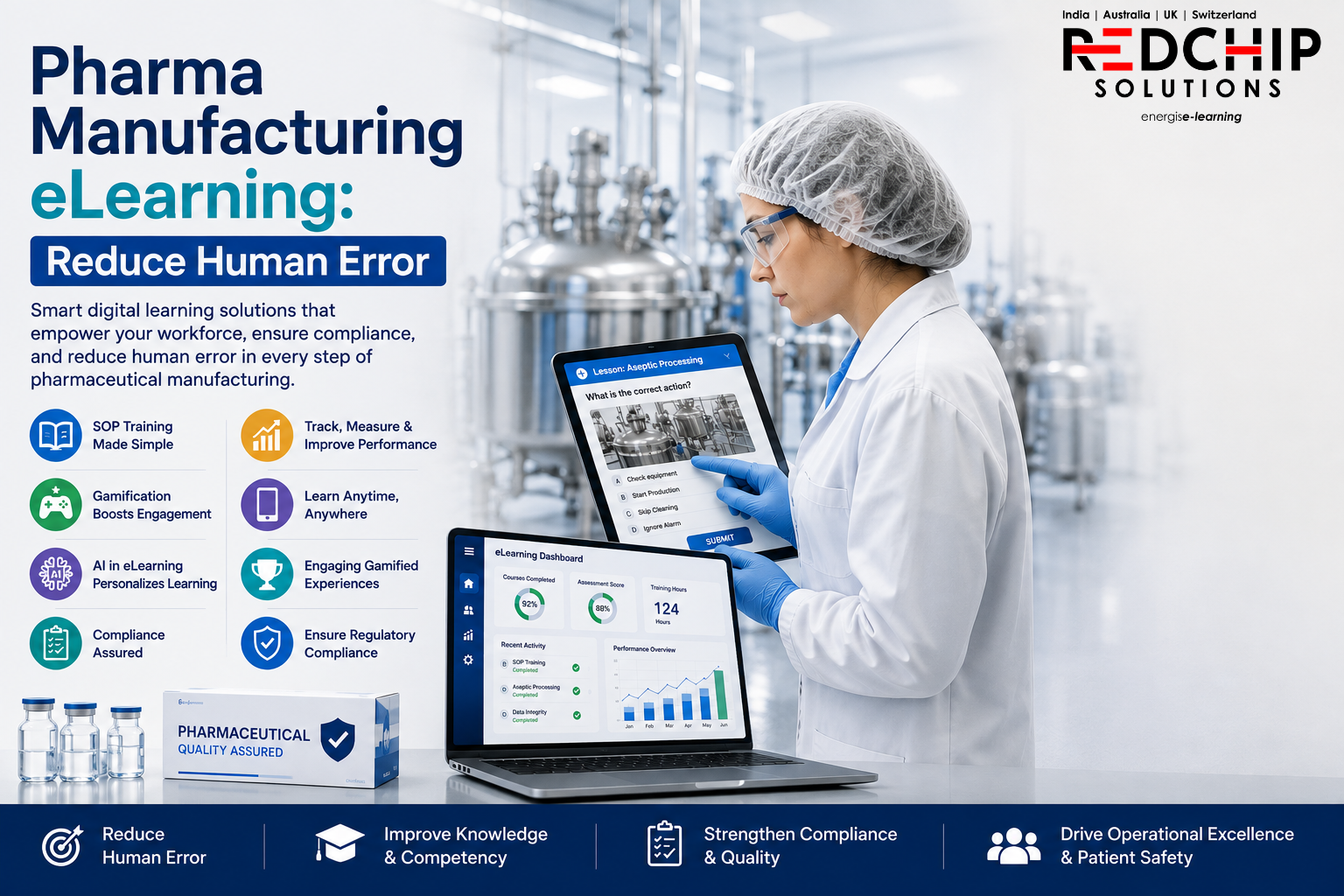
Pharma Manufacturing eLearning can help pharma companies reduce human error, improve SOP knowledge, and support safer, more consistent production. In a highly controlled environment, even a small mistake can lead to an incorrect process step, poor documentation, equipment issues, or a failed quality check. Therefore, pharma companies need training that goes beyond simply asking employees to read SOPs and complete yearly courses.
Instead, modern custom eLearning solutions can turn complex procedures into clear, practical learning experiences. Employees can learn the correct process, practice decisions, and receive feedback before they face the same situation on the production floor.
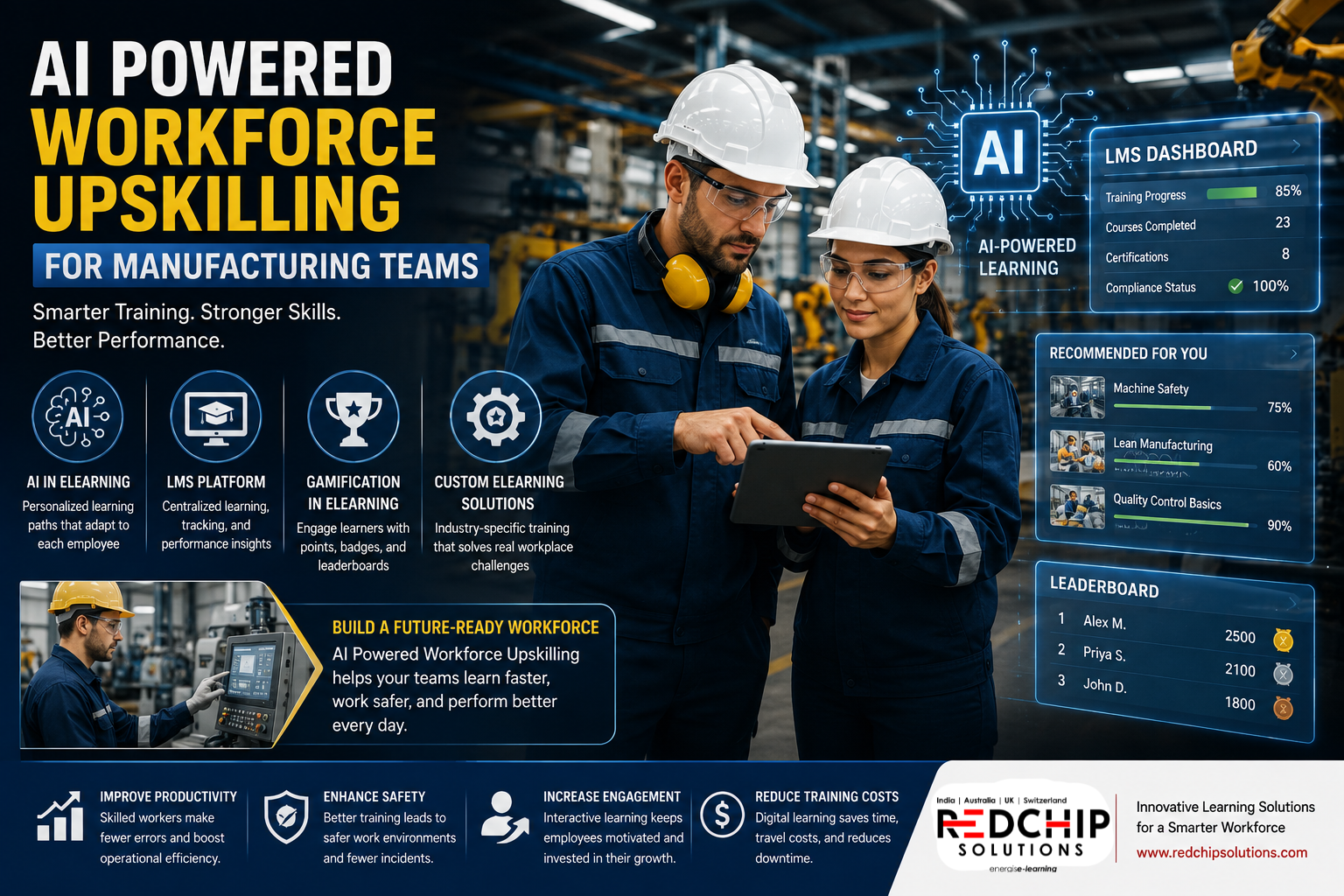
Moreover, AI in eLearning, gamification in eLearning, and a well-designed eLearning platform can make this training easier to access and track. As a result, organizations can build stronger skills while also supporting quality and compliance goals.
For organizations looking to improve workforce training, Requesting for a Demo can be a useful next step to discuss specific training needs.
What This Guide Covers
This guide explains how Pharma Manufacturing eLearning can improve workforce training, reduce process errors, and support better learning outcomes.
- Common causes of human error in pharma manufacturing
- The role of SOP-based digital training
- How gamification improves learner attention
- How AI can support personalized learning
- The value of custom eLearning solutions
- How an eLearning platform can track training
- Ways to measure learning and performance
- How Red Chip Solutions approaches modern eLearning
You can also Explore Red Chip Solutions Portfolio to see examples of digital learning projects across different industries.
Human Error in Pharma Manufacturing: Common Causes
Pharma Manufacturing eLearning can address common causes of human error by helping employees understand procedures and practice the right actions. Employees may understand an SOP but still struggle when they need to apply it under time pressure or in an unusual situation.
For example, a worker may know that a process requires a specific check. However, if the training only presents the rule as text, the learner may not understand when that check becomes critical.
Several factors can increase the risk:
- Complex procedures
- Large amounts of technical information
- Poorly designed SOP training
- Infrequent refresher training
- Lack of practice
- Manual data entry
- Communication gaps
- New equipment or processes
- High workload
- Weak feedback after assessments
Therefore, effective training should focus not only on what employees need to know, but also on what they need to do.
Custom eLearning Solutions for Pharma Manufacturing
Custom eLearning solutions make Pharma Manufacturing eLearning more relevant because training can be built around actual SOPs, equipment, processes, and job roles. Rather than using a generic course, companies can build training around their own SOPs, equipment, quality systems, job roles, and compliance needs.
For instance, a production operator could complete a short module that shows a production task step by step. Next, the learner could make decisions inside a realistic scenario. Finally, an assessment could test whether the learner knows what to do when something goes wrong.
This approach makes training more practical.
Furthermore, eLearning content development can combine:
- SOP-based modules
- Scenario-based learning
- Interactive diagrams
- Short videos
- Simulations
- Knowledge checks
- Decision-based activities
- Microlearning
- Assessments
Consequently, employees are not simply reading procedures. Instead, they are practicing how those procedures should be applied.
Gamification in eLearning for Pharma Teams
Gamification in eLearning can make Pharma Manufacturing eLearning more engaging by turning routine training into interactive challenges and practice activities. However, good gamification is not about adding games just for entertainment.
Instead, the goal is to encourage the learner to think, respond, and remember.
A pharma training course could use points, badges, progress levels, challenges, or scenario-based missions. For example, learners might enter a virtual production area and identify process risks before moving to the next stage.
Similarly, a quality training module could present a documentation problem and ask the learner to select the correct action.
As a result, the employee gets immediate feedback while the organization gains a better way to reinforce key behaviors.
Gamification for SOP and Quality Training
Gamification can also make SOP training easier to remember. For example, instead of presenting ten pages of process rules, a course can divide the information into short challenges.
First, the learner completes a process step. Then, a question tests understanding. After that, a scenario tests application. Finally, feedback explains why the selected action was correct or incorrect.
Therefore, gamification can support learning without reducing the seriousness of pharma compliance.
AI in eLearning for Smarter Pharma Training
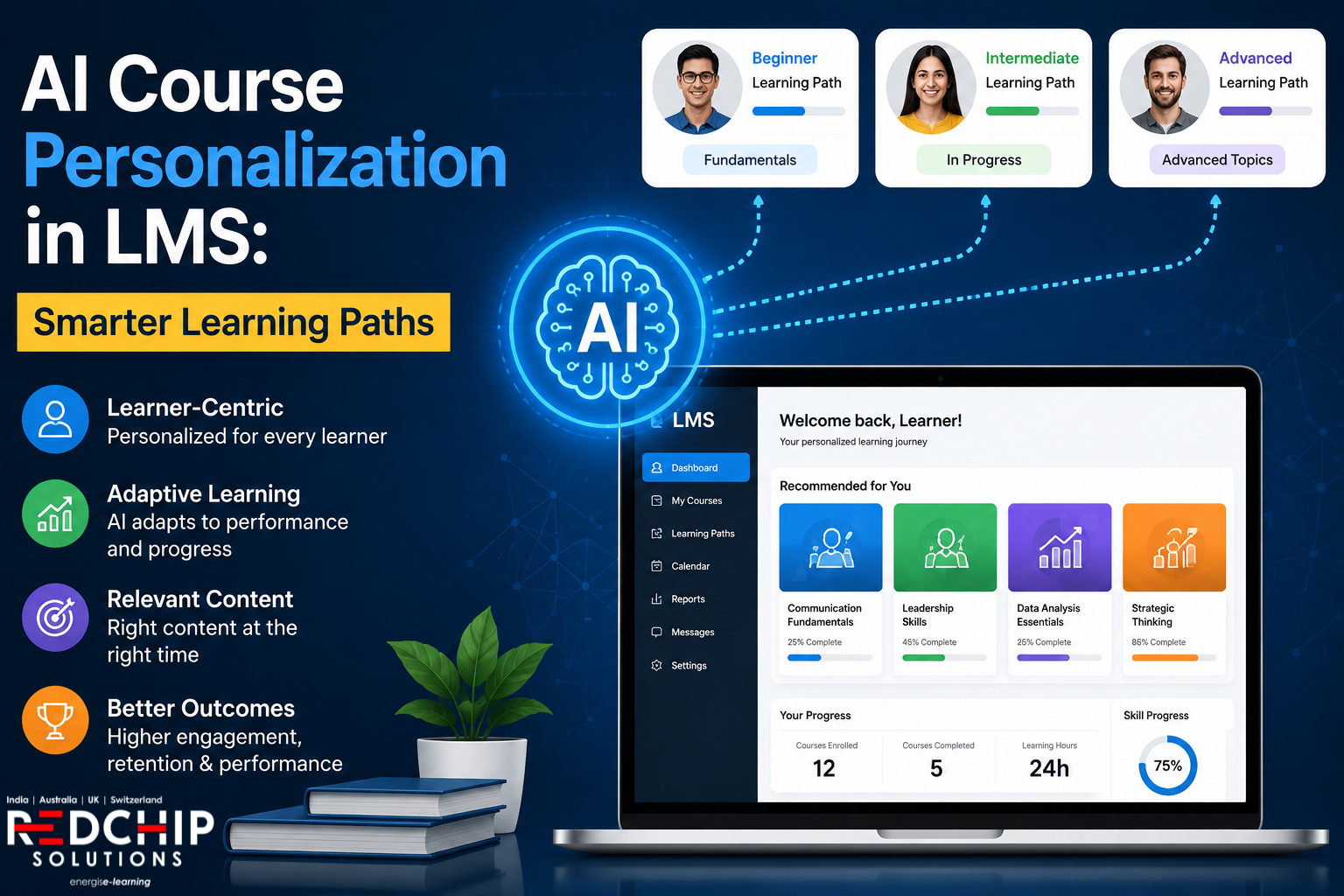
AI in eLearning can make Pharma Manufacturing eLearning more personalized by helping identify knowledge gaps and recommend relevant learning content. Instead of giving every employee exactly the same learning path, AI can help identify knowledge gaps and recommend suitable content.
For example, if an employee performs well in equipment safety but struggles with documentation rules, the learning system can direct that employee toward additional documentation practice.
Likewise, AI can support learning assistants, question generation, content recommendations, and skill-gap analysis.
However, AI should support the learning strategy rather than replace expert review. In pharma, accuracy matters. Therefore, training content should still be reviewed by the right subject matter experts and compliance teams.
The result is a balance between technology and human expertise.
eLearning Content Development for Pharma Training
eLearning content development is an important part of Pharma Manufacturing eLearning because complex pharma processes must be turned into clear and useful learning experiences. The content should be clear, focused, and connected to the employee’s actual work.
Instead of filling a course with long blocks of text, learning designers can use short sections, visuals, scenarios, and practice tasks.
For example, a module about equipment cleaning could show:
- The correct preparation steps.
- The required safety checks.
- A common mistake.
- The possible impact of that mistake.
- The correct response.
- A short knowledge check.
This structure makes the learning easier to follow.
Moreover, eLearning content providers with strong instructional design skills can help subject matter experts convert complex information into learner-friendly digital content.
eLearning Platform: Track Training and Identify Gaps
An eLearning platform gives Pharma Manufacturing eLearning a central place to deliver, manage, and track employee training.
For example, an LMS can help managers monitor:
- Course completion
- Assessment scores
- Employee progress
- Refresher training
- Compliance status
- Learning history
- Role-based assignments
- Training gaps
More importantly, these reports can help L&D and compliance teams identify where learners may need additional support.
A strong platform can also make it easier to assign different courses to operators, supervisors, quality teams, maintenance staff, and other roles.
Thus, training becomes more structured rather than relying on manual follow-ups.
Choosing eLearning Content Providers for Pharma Training
The right eLearning content providers should understand both learning design and the business problem behind the training.
A pharma company should look beyond attractive visuals. Instead, ask whether the provider can understand SOPs, map learning objectives, build realistic scenarios, support assessments, and create measurable learning outcomes.
In addition, the provider should be able to work with existing systems and content.
Red Chip Solutions positions itself as a modern eLearning partner, offering custom eLearning solutions, custom content development, scenario-based learning, games and gamification, LMS solutions, and AI-powered learning services. (Red Chip Solutions)
This combination is useful when a company needs more than a standard off-the-shelf course.
How to Measure Human Error in Pharma Manufacturing Training
Reducing human error in pharma manufacturing requires more than measuring course completion. Completion tells you that an employee finished the training. However, it does not always show whether behavior improved.
Therefore, companies should consider a wider set of measures.
These can include:
- Assessment performance
- Repeat errors
- SOP deviations
- Retraining needs
- Quality findings
- Knowledge retention
- Time to competency
- Process compliance
- Employee confidence
For example, if a team completes 100% of its training but the same process errors continue, the learning strategy may need to change.
On the other hand, if error trends improve after targeted scenario training, the organization has stronger evidence that learning is supporting performance.
Why Modern eLearning Should Connect Learning With Work
Effective Pharma Manufacturing eLearning should connect digital learning with the real tasks employees perform on the manufacturing floor.
Therefore, a strong pharma learning program should not treat training as a separate activity. Instead, it should connect SOPs, workplace tasks, assessments, refresher learning, and performance needs.
Microlearning can help employees revisit a specific process quickly. Similarly, simulations can provide practice before a real task. Gamification can improve engagement, while AI can help personalize the learning path.
Together, these methods can create a more complete learning experience.
For organizations exploring this approach, the FDA’s guidance on data integrity and CGMP is also a useful external reference. The guidance highlights the importance of personnel having the education, training, and experience needed for assigned responsibilities. (U.S. Food and Drug Administration)
Red Chip Solutions: A Modern eLearning Partner for Pharma Training
Red Chip Solutions uses Pharma Manufacturing eLearning, custom eLearning solutions, AI, gamification, and LMS technology to create practical workforce learning experiences.
The company has been working in the eLearning space since 2007 and provides solutions that include custom eLearning, scenario-based learning, games and gamification, custom content development, and LMS services. (Red Chip Solutions)
Additionally, its AI-powered learning services can support personalized learning paths, knowledge access, LMS integration, and skill-gap analysis. (Red Chip Solutions)
For pharma organizations, this means training can be designed around actual business needs rather than forcing the organization into a fixed course format.
That matters because every manufacturing environment has its own processes, roles, risks, and learning gaps.
Conclusion: Reduce Human Error in Pharma Manufacturing With Better Learning
Pharma Manufacturing eLearning can play an important role in reducing human error while helping pharma teams improve knowledge, process awareness, and compliance. Instead, organizations need learning that helps employees understand procedures, practice decisions, remember key steps, and apply knowledge correctly.
Therefore, custom eLearning solutions, gamification in eLearning, AI in eLearning, strong eLearning content development, capable eLearning content providers, and a reliable eLearning platform can work together to create a stronger training system.
Most importantly, the focus should remain on real workplace performance.
Red Chip Solutions combines learning design, technology, LMS capabilities, AI, gamification, and custom development to help organizations build modern learning experiences. (Red Chip Solutions)
If your pharma organization is facing training gaps, repeated process errors, or challenges with SOP learning, now is the right time to review your learning strategy.
Request a Demo and discuss how Red Chip Solutions can design a learning solution around your workforce, processes, and business goals.