
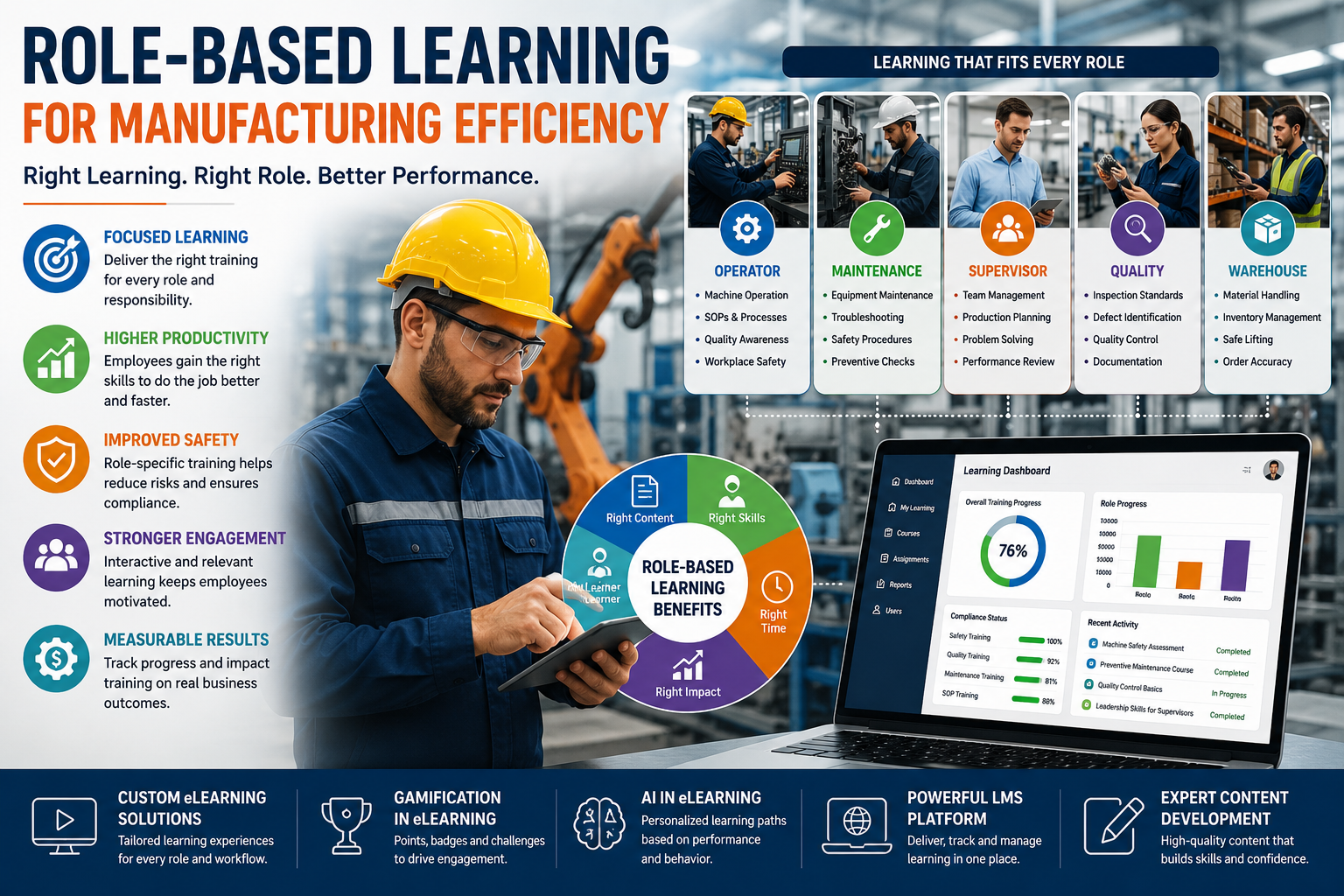
Role-Based Learning is becoming increasingly useful for manufacturers that need to train employees with different jobs, skills, machines, and safety responsibilities. A production operator does not need the same training as a maintenance technician, while a supervisor may need a different set of skills again.
However, many manufacturing companies still provide the same training to large groups of employees. As a result, workers may spend time learning information that does not directly relate to their daily tasks.
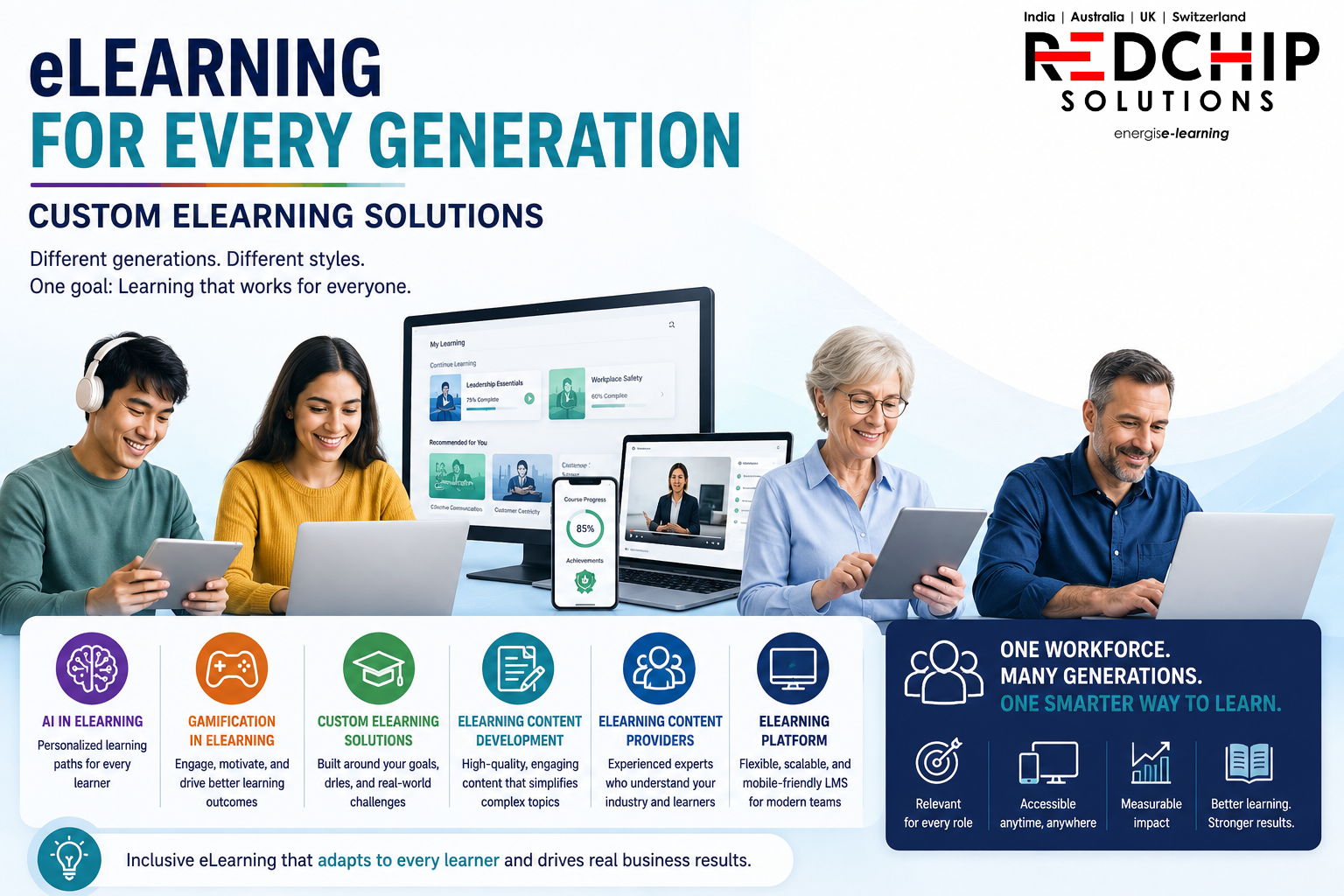
A better approach is to build learning around each employee’s role, tasks, skill level, and responsibilities. Custom eLearning solutions, eLearning content development, gamification in eLearning, and AI in eLearning can help create focused learning paths. Meanwhile, an eLearning platform can bring these learning experiences together and help managers track employee progress.
The U.S. National Institute of Standards and Technology (NIST) also highlights workforce development as an important part of helping manufacturers build the skills needed across production and leadership roles.
Requesting for a Demo to discuss how role-based digital learning can support your manufacturing workforce.
What This Guide Covers
This guide explains how Role-Based Learning can help manufacturers make training more relevant and useful.
Here is what you will find:
- Why role-based training matters in manufacturing
- How to create learning paths for different job roles
- How custom eLearning solutions can support different teams
- How gamification can improve practice and engagement
- How AI can support personalized learning
- Why eLearning content development should start with real job tasks
- How an eLearning platform can manage different learning paths
- What to look for in eLearning content providers
- How to measure the impact of manufacturing training
- How Red Chip Solutions can support modern workforce learning
Why Role-Based Learning Matters in Manufacturing
Role-Based Learning matters because employees perform different tasks and face different risks across a manufacturing operation.
Consider a plant with production operators, maintenance technicians, quality inspectors, warehouse staff, supervisors, and managers. Each team works with different equipment, processes, decisions, and safety requirements.
For example, a production operator may need to understand machine operation, SOPs, quality checks, and PPE. Meanwhile, a maintenance technician may need more detailed training on equipment checks, troubleshooting, and maintenance safety.
Similarly, a quality inspector may focus on inspection standards, defect identification, and reporting.
Therefore, giving every employee the same learning path may not be the most efficient approach.
Role-Based Learning allows organizations to create common training where needed while also providing role-specific learning for individual teams.
OSHA recommends training workers on the hazards they may encounter in their own jobs and providing additional training when workers receive new tasks or when changes in equipment, processes, or materials create new risks.
Custom eLearning Solutions for Different Manufacturing Roles
Custom eLearning solutions make Role-Based Learning more practical by allowing manufacturers to create training around specific jobs, tasks, and skill levels.
Instead of creating one large manufacturing course, learning teams can divide content into smaller modules based on employee roles.
Training for Production Operators
Production operators may need training on:
- Machine operation
- Standard operating procedures
- Quality checks
- Workplace safety
- PPE
- Production processes
- Common machine errors
Training for Maintenance Teams
Maintenance employees may require:
- Preventive maintenance
- Equipment checks
- Troubleshooting
- Machine safety
- Lockout/tagout procedures
- Maintenance records
- Emergency response
Developing Skills for Manufacturing Supervisors
Supervisors may need a different learning path covering:
- Team leadership
- Production planning
- Safety leadership
- Incident reporting
- Quality monitoring
- Performance discussions
- Process improvement
As a result, custom eLearning solutions help employees focus on information that connects directly to their work.
Making Training More Engaging with Gamification
Gamification in eLearning can make Role-Based Learning more engaging when game elements are linked to real manufacturing skills.
Manufacturing employees may need regular refresher training on safety, quality, machine processes, and SOPs. However, repeating the same slides every year can become routine.
Instead, simple game elements can encourage employees to practise important skills.
For example, a learner could enter a simulated production line and complete a series of safety checks. Each correct decision moves the learner forward.
Training can include:
- Points
- Levels
- Badges
- Progress bars
- Challenges
- Scenario-based tasks
- Achievement milestones
However, gamification should have a clear purpose.
A safety course should not become a game simply for entertainment. Instead, gamification in eLearning should encourage learners to repeat important actions, test their decisions, and understand the results of mistakes.
AI in eLearning for Personalized Training
AI in eLearning can support Role-Based Learning by helping organizations create more personalized learning paths.
Manufacturing teams often have employees with different levels of experience. For example, a new operator may need basic machine training, while an experienced operator may need advanced troubleshooting practice.
AI-supported learning can help recommend different learning activities based on employee performance.
Employees can receive different learning paths based on their performance and training needs. For example, an employee with strong SOP knowledge can progress to advanced machine scenarios, while an employee with a weak safety assessment can receive additional safety practice. Similarly, an employee who understands the process but repeatedly makes task-related errors can be given more task-based scenarios to strengthen practical performance.
As a result, employees can spend more time practising the areas where they need support.
Moreover, AI can help identify patterns in assessment results and highlight common knowledge gaps.
At the same time, organizations should keep human review in the process. Subject matter experts should review AI-supported content and recommendations, especially when training covers safety, regulated processes, or critical manufacturing operations.
Role-Based Learning Through an eLearning Platform
An eLearning platform gives organizations a central place to deliver, manage, and track Role-Based Learning across different teams.
Manufacturing companies may have hundreds or thousands of employees working across plants, departments, shifts, and locations. Managing their training manually can quickly become difficult.
An eLearning platform can assign learning based on factors such as:
- Job role
- Department
- Location
- Experience
- Training history
- Skill level
- New responsibilities
For example, when a new maintenance employee joins the company, the platform can assign the required maintenance learning path.
Later, if that employee moves into a supervisory role, additional leadership and production management training can be assigned.
Therefore, the eLearning platform becomes an important part of managing role-based workforce development.
Managers can also review:
- Course completion
- Assessment results
- Skill gaps
- Refresher needs
- Employee progress
- Training records
Role-Based Learning for Manufacturing Safety
Role-Based Learning can make safety training more relevant because employees can learn about the risks connected to their actual work.
A machine operator and a maintenance technician may work around the same equipment, but their tasks and risks can be very different.
For example, an operator may need to understand machine guarding and safe operation. Meanwhile, a maintenance technician may need more detailed training on equipment isolation and maintenance procedures.
However, digital learning should not be treated as a replacement for hands-on training where practical instruction is required.
Instead, Role-Based Learning can support knowledge, preparation, refresher training, and assessment alongside practical workplace training.
How to Build a Role-Based Learning Program
A Role-Based Learning program can start with a small number of important roles instead of trying to create hundreds of courses at once.
Step 1: Map Roles for Role-Based Learning
First, list the main job roles in the organization.
Start with production, maintenance, quality, warehouse, supervisors, and other key teams.
Step 2: Identify Skills for Each Role
Next, identify the skills employees need to perform their work correctly.
At this stage, speak with managers and subject matter experts to understand the real needs of each role.
Step 3: Create Role-Based Learning Paths
Then, separate common topics from role-specific topics.
For example, workplace safety may be shared across several teams, while machine troubleshooting may be specific to maintenance staff.
Step 4: Add Practice to Role-Based Learning
After that, add scenarios, simulations, assessments, or interactive activities where they provide real value.
This gives employees an opportunity to practise before applying the skill at work.
Step 5: Track Role-Based Learning Results
Finally, use the eLearning platform to track progress and identify areas that need more attention.
This creates a simple learning cycle:
Role → Skills → Learning → Practice → Assessment → Improvement
Building Better eLearning Content for Manufacturing
eLearning content providers should understand both digital learning and the practical needs of manufacturing employees.
Manufacturing training can include SOPs, technical processes, safety rules, equipment information, quality standards, and role-specific tasks.
Therefore, your learning partner should be able to work closely with subject matter experts.
Before selecting eLearning content providers, ask:
- Can they create custom content?
- Can they convert SOPs into interactive learning?
- Can they create realistic scenarios?
- Can they develop simulations?
- Can they create assessments?
- Can they work with your SMEs?
- Can their content integrate with your LMS?
- Can they support multiple languages if required?
- Can they update content when processes change?
A strong provider should also understand that manufacturing learning needs to be clear, practical, and connected to workplace performance.
Measuring Manufacturing Efficiency with Role-Based Learning
Measuring Role-Based Learning requires more than checking whether employees completed their courses.
Course completion tells you that an employee finished the training. However, it does not always tell you whether the employee can apply the skill correctly.
Therefore, manufacturers should also review:
- Assessment scores
- Scenario performance
- Repeat errors
- Time taken to complete tasks
- Safety knowledge
- Quality-related errors
- Refresher training needs
- Supervisor feedback
- Skill progression
For example, if operators complete a machine safety course but continue making the same process errors, the learning program may need more practical activities.
As a result, eLearning content development should continue after the course is launched.
Training teams can use learner data and workplace feedback to identify what needs to be updated, simplified, or practised more often.
Red Chip Solutions for Role-Based Manufacturing Learning
Red Chip Solutions brings custom eLearning solutions, eLearning content development, interactive learning, LMS technology, AI-powered learning, and scenario-based training together to support modern workforce learning.
For manufacturing organizations, this approach can help turn SOPs, process documents, safety material, and technical knowledge into structured digital learning.
Red Chip Solutions provides custom eLearning solutions along with its Redovator LMS and other learning services designed around organizational training needs.
The company’s work spans several industries, including manufacturing-related learning requirements where technical information needs to be presented in a clear and practical format.
You can Explore the Red Chip Solutions Portfolio to see examples of its learning projects across different industries.
The value of this approach is simple: instead of forcing every employee through the same training, organizations can create learning experiences that match the employee’s role and actual work.
For companies looking for a modern eLearning partner, Red Chip Solutions positions itself around customized, technology-enabled learning rather than one-size-fits-all course delivery.
What Makes Role-Based Learning Effective?
Effective Role-Based Learning should be relevant, practical, simple, trackable, and easy to update.
Relevant Role-Based Learning
Employees should see a clear connection between the course and their daily work.
Practical Role-Based Learning
Training should include tasks, decisions, examples, and practice wherever possible.
Simple Role-Based Learning
Content should explain technical information in a clear way without unnecessary complexity.
Trackable Role-Based Learning
Managers should be able to see progress, assessment results, and areas that need improvement.
Flexible Role-Based Learning
Learning paths should be easy to update when employees change jobs, machines, processes, or responsibilities.
Scalable Role-Based Learning
Finally, the system should allow new roles, locations, and learning modules to be added as the organization grows.
Conclusion: Role-Based Learning for Manufacturing Efficiency
Role-Based Learning gives manufacturers a practical way to connect employee training with real workplace responsibilities. Instead of giving everyone the same learning experience, organizations can create focused paths around roles, skills, tasks, and risks.
With custom eLearning solutions, manufacturers can design learning for production operators, maintenance teams, quality staff, supervisors, and other groups. Meanwhile, eLearning content development can turn SOPs, technical information, and workplace processes into useful digital learning.
At the same time, gamification in eLearning can encourage practice and engagement, while AI in eLearning can support more personalized learning paths. An eLearning platform can then bring these experiences together and help managers track progress.
Finally, experienced eLearning content providers can help manufacturers combine instructional design, technology, and workplace knowledge into a more useful learning program.
For organizations looking to move beyond one-size-fits-all training, Red Chip Solutions provides custom eLearning solutions designed around modern workforce learning needs.
Ready to build Role-Based Learning for your manufacturing teams? Requesting for a Demo and discuss your workforce, skill gaps, and training goals with Red Chip Solutions.