
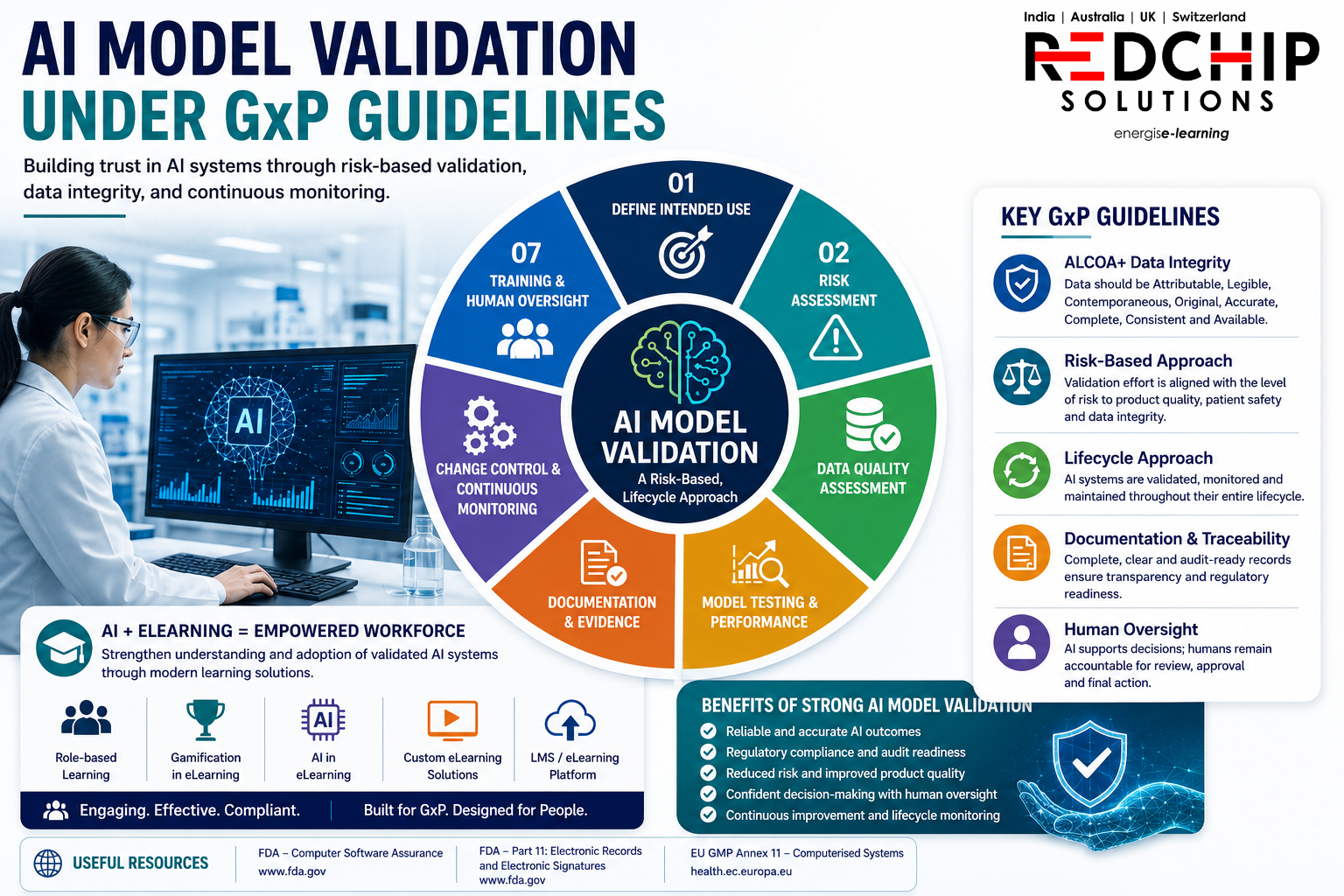
AI Model Validation is becoming increasingly important for pharmaceutical, biotech, and life sciences organizations that use artificial intelligence in regulated environments. AI can support quality reviews, manufacturing analysis, document management, employee training, and many other business tasks. However, simply getting useful results from an AI system does not mean that the system is ready for a GxP environment.
Instead, organizations need to show that the system is suitable for its intended use, properly controlled, tested, documented, and monitored.
At the same time, AI in eLearning can help employees understand how approved AI systems should be used. Furthermore, custom eLearning solutions can turn complex GxP requirements into practical training that reflects real workplace tasks.
Therefore, the goal is not only to introduce AI. The goal is to introduce AI while protecting quality, data integrity, patient safety, and compliance.
Requesting for a Demo If you are planning a GxP learning program, you can contact Red Chip Solutions to discuss your requirements.
What This Guide Covers
This guide explains the main steps involved in AI validation for regulated organizations, including:
- Defining the intended use of an AI system
- Applying a risk-based validation approach
- Reviewing data quality
- Testing model performance
- Creating validation evidence
- Managing system changes
- Training employees
- Using AI in eLearning
- Building custom eLearning solutions
- Selecting the right eLearning platform
What Makes AI Model Validation Important Under GxP?
AI Model Validation is important because regulated organizations must be able to show that computerized systems perform consistently and are suitable for their intended use.
AI systems can create additional challenges because their outputs may depend on data, model design, configuration, prompts, integrations, and other factors.
Therefore, organizations should consider:
- Intended use
- Risk level
- Data quality
- Model performance
- Human oversight
- System controls
- Documentation
- Change management
Moreover, the validation approach should match the potential impact of the AI system.
For example, an AI tool used to recommend optional learning content may require a different level of control than an AI system that supports a regulated quality process.
As a result, GxP AI validation should begin with a clear understanding of how the system will be used.
AI Model Validation Starts With Intended Use
First, every validation project should clearly define what the AI system is expected to do.
This step may sound basic. However, it can have a major impact on the rest of the validation process.
For example, an AI tool that helps employees find information in a training library has a very different risk profile from an AI system that supports a manufacturing quality decision.
Therefore, organizations should document:
- The purpose of the AI system
- Who will use it
- What data it receives
- What output it produces
- Where the output will be used
- What decisions depend on it
- What happens if the output is incorrect
In addition, defining intended use makes it easier to establish suitable acceptance criteria.
Consequently, the intended-use statement provides a clear starting point for the AI validation process.
Building a Risk-Based AI Model Validation Process
Next, organizations should determine the level of risk associated with the AI application.
A risk-based approach helps teams avoid treating every AI application in exactly the same way. Instead, validation effort can be matched to the potential impact on product quality, patient safety, and data integrity.
Low-Risk AI Applications
For instance, lower-risk applications may include:
- Employee knowledge search
- Training recommendations
- General learning assistants
- Internal content discovery
Medium-Risk AI Applications
Similarly, medium-risk applications may support:
- Quality trend analysis
- Workflow recommendations
- Training performance analysis
- Document review
Higher-Risk AI Applications
On the other hand, higher-risk systems may influence:
- Manufacturing decisions
- Quality processes
- Batch-related activities
- Regulated decision support
Consequently, higher-risk applications generally require stronger controls, testing, documentation, and oversight.
Organizations can also review EU GMP Annex 11 guidance when planning controls for computerized systems in regulated environments.
AI in eLearning for GxP AI Model Validation
Meanwhile, AI in eLearning can help employees understand new AI-based workflows and validation requirements.
Instead of giving every employee the same learning path, AI-enabled learning can help identify knowledge gaps and recommend relevant training.
For example, an AI in eLearning program could provide:
- Personalized learning paths
- Adaptive assessments
- Knowledge-gap analysis
- Automated learning recommendations
- Practice activities
- Revision suggestions
However, personalization should not remove human oversight. Instead, AI should support trainers, subject matter experts, and quality teams.
As a result, employees can receive more relevant learning while the organization maintains control over the training process.
Custom eLearning Solutions for AI Validation Training
Furthermore, custom eLearning solutions can help organizations train employees on AI systems that are specific to their own processes.
Generic AI courses may explain what artificial intelligence is. However, employees often need to know something more practical:
What should I do when I use this AI system at work?
A custom course can answer that question.
For example, a custom eLearning solution can teach employees how to:
- Access an approved AI application.
- Enter information correctly.
- Review the AI-generated output.
- Identify an unusual result.
- Apply human judgment.
- Report an issue.
- Follow the relevant SOP.
- Complete the required documentation.
Therefore, custom learning connects regulatory expectations with daily work.
Data Quality in the AI Model Validation Process
Data quality is a critical part of AI Model Validation because unreliable data can affect the accuracy and reliability of an AI system.
An AI model can only provide useful results when the data supporting it is suitable for the intended purpose. Therefore, validation teams should look at the complete data flow.
Important areas include:
- Data accuracy
- Data completeness
- Data consistency
- Data sources
- Data lineage
- Data access
- Data security
- Data retention
Moreover, teams should understand how data enters the system, how it is processed, and how results are produced.
This is particularly important when AI systems connect with multiple business applications.
For additional regulatory context, organizations can review the FDA guidance on Computer Software Assurance.
eLearning Content Development for AI Validation
eLearning content development can support AI Model Validation training by helping employees understand their role in approved AI workflows.
Rather than asking employees to read long technical documents, organizations can break the content into practical learning activities.
For example, courses can include:
- Interactive SOP walkthroughs
- AI risk scenarios
- Decision-based activities
- Short videos
- Knowledge checks
- Simulated workflows
- Case studies
- Final assessments
Furthermore, scenario-based learning allows employees to practise what they should do when an AI system produces an unexpected result.
As a result, learning becomes more practical and less dependent on simple information recall.
Gamification in eLearning for GxP Training
Similarly, gamification in eLearning can make AI and GxP training more engaging.
For example, learners could complete a simulated validation exercise. During the activity, they may need to identify a risk, review data, select a test, evaluate an AI result, and decide whether human review is needed.
Useful elements include:
- Scenario challenges
- Progress levels
- Decision activities
- Achievement milestones
- Instant feedback
- Competency scores
However, gamification should support the learning goal rather than distract from it.
Therefore, gamification in eLearning works best when it reflects real decisions employees may face during an AI validation process.
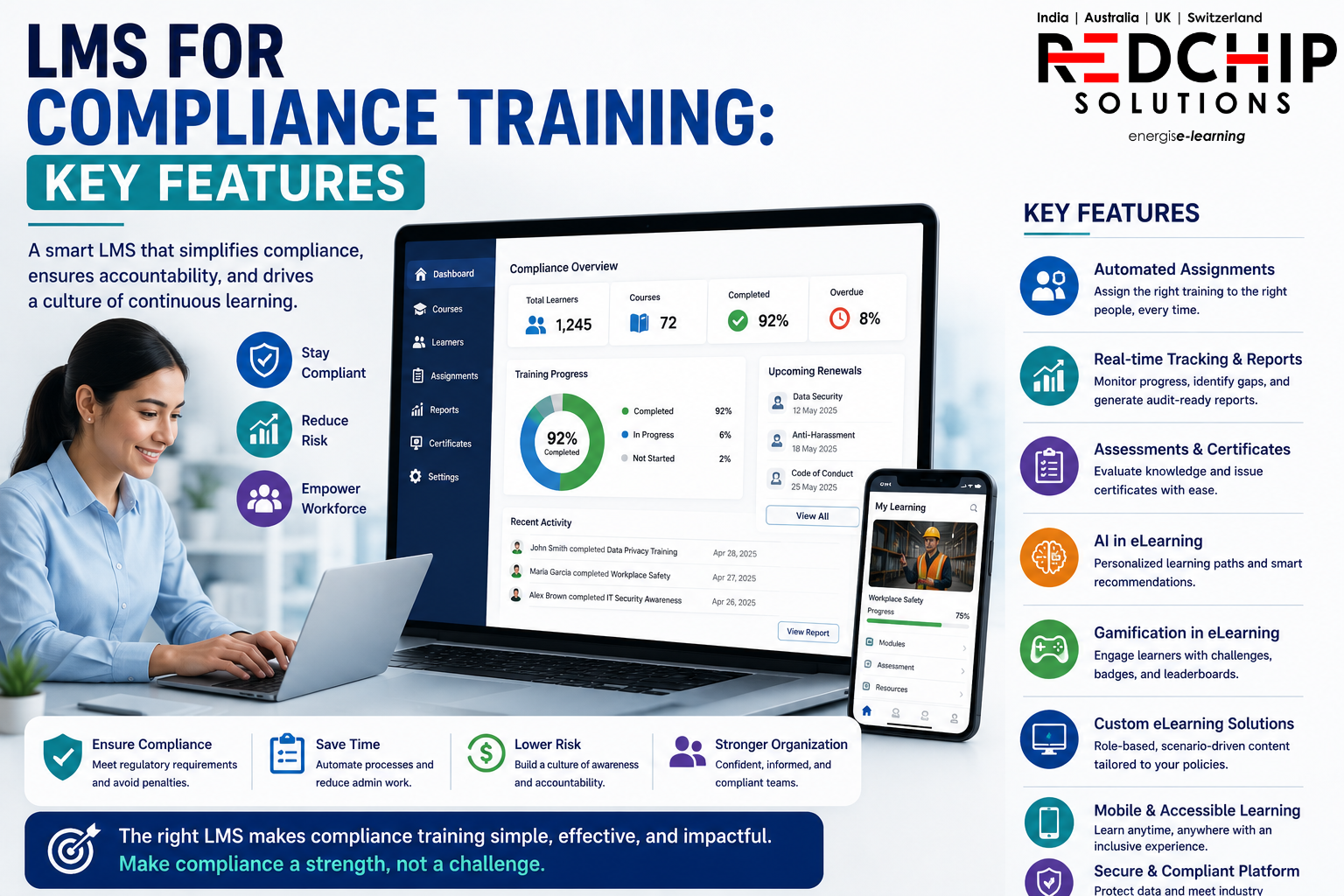
eLearning Platform Controls for Regulated Training
An eLearning platform should support more than course delivery.
For regulated organizations, the platform may also need to support:
- User access
- Role-based learning
- Course assignment
- Assessment tracking
- Completion records
- Training reports
- Content versions
- Learning history
In addition, managers should be able to identify who has completed required training and who still needs to take action.
Consequently, the LMS becomes an important part of the overall learning and compliance process.
Choosing eLearning Content Providers for GxP AI Training
The choice of eLearning content providers also matters.
A provider working on GxP AI training should understand more than visual design. They should also be comfortable working with subject matter experts, SOPs, regulated workflows, assessments, and LMS requirements.
Before selecting an eLearning content provider, ask:
- Can the team work with internal SMEs?
- Can they convert SOPs into practical learning?
- Can they create scenario-based content?
- Can they support assessments?
- Can they integrate learning with an LMS?
- Can they manage content revisions?
- Can they design learning for different employee roles?
Most importantly, the provider should understand that compliance learning must be accurate, clear, and useful.
Documentation and Evidence for AI Model Validation
Documentation provides the evidence needed to demonstrate that AI Model Validation activities were planned, completed, and reviewed.
A validation package may include:
- User requirements
- Functional requirements
- Risk assessment
- Validation plan
- Test cases
- Test results
- Traceability records
- Approval records
- Change history
- Training evidence
Furthermore, each document should support the overall validation story.
The FDA’s Part 11 guidance on electronic records and electronic signatures is another useful resource when evaluating systems involving electronic records and signatures.
Therefore, organizations should plan documentation from the beginning rather than trying to create missing evidence at the end.
Change Control After AI Model Validation
After AI Model Validation is completed, change control helps ensure that later system changes do not introduce new risks.
AI systems may change because of:
- New data
- Model updates
- Software updates
- Prompt changes
- Integration changes
- Workflow changes
- New business requirements
Therefore, every significant change should be reviewed through an appropriate change-control process.
The team should determine:
- What changed?
- Why was it changed?
- Does the risk profile change?
- Is additional testing required?
- Is revalidation needed?
- Do users require retraining?
- Should documentation be updated?
As a result, organizations can maintain control as the AI system evolves.
AI Model Validation Checklist
Before deploying an AI system in a GxP environment, review the following:
- Is the intended use documented?
- Has the risk been assessed?
- Are data sources known?
- Has data quality been reviewed?
- Are acceptance criteria clear?
- Has performance been tested?
- Have unusual cases been tested?
- Is human oversight defined?
- Is validation evidence documented?
- Is change control established?
- Is ongoing monitoring planned?
- Have users received appropriate training?
If several answers are unclear, the system may need additional review before deployment.
Red Chip Solutions for AI Model Validation
Red Chip Solutions supports AI Model Validation training through custom eLearning solutions, AI in eLearning, gamification in eLearning, eLearning content development, and LMS-based learning.
The company has experience developing interactive learning for industries where employees need clear, practical, and role-based training. Its published work also includes pharmaceutical learning projects.
For example, its pharmaceutical case study describes an interactive employee induction experience using eLearning, AI-generated voice and video, animations, and game-based activities.
You can explore Red Chip Solutions’ eLearning portfolio to review examples of its work.
The focus is not simply on making courses look modern. Instead, the aim is to create learning that employees can understand, use, and apply.
Why Custom eLearning Solutions Matter for GxP AI Adoption
As AI adoption grows, employees will need more than basic AI awareness.
They will need to understand approved use, data handling, human oversight, risks, and escalation steps.
Therefore, custom eLearning solutions can help organizations build role-specific training for:
- Manufacturing teams
- Quality teams
- Regulatory teams
- Pharmacovigilance teams
- IT teams
- Validation teams
- New employees
- Managers
Moreover, learning can be updated as AI systems and company procedures change.
This creates a more flexible training model while supporting consistent knowledge across the workforce.
Conclusion: Building Trust Through AI Model Validation
AI Model Validation is an important part of responsible AI adoption in GxP environments. However, successful validation is not only about technical testing. It also requires clear requirements, risk assessment, suitable data, documented evidence, human oversight, change control, and trained employees.
At the same time, AI in eLearning, custom eLearning solutions, gamification in eLearning, and strong eLearning content development can help employees understand how AI should be used within regulated workflows.
Furthermore, the right eLearning content providers and eLearning platform can make training easier to manage, update, measure, and scale.
Red Chip Solutions brings these elements together through modern digital learning, interactive content, custom development, gamification, and LMS-based solutions.
Ready to build stronger GxP AI training? Request a Demo from Red Chip Solutions and discuss your organization’s learning requirements.