
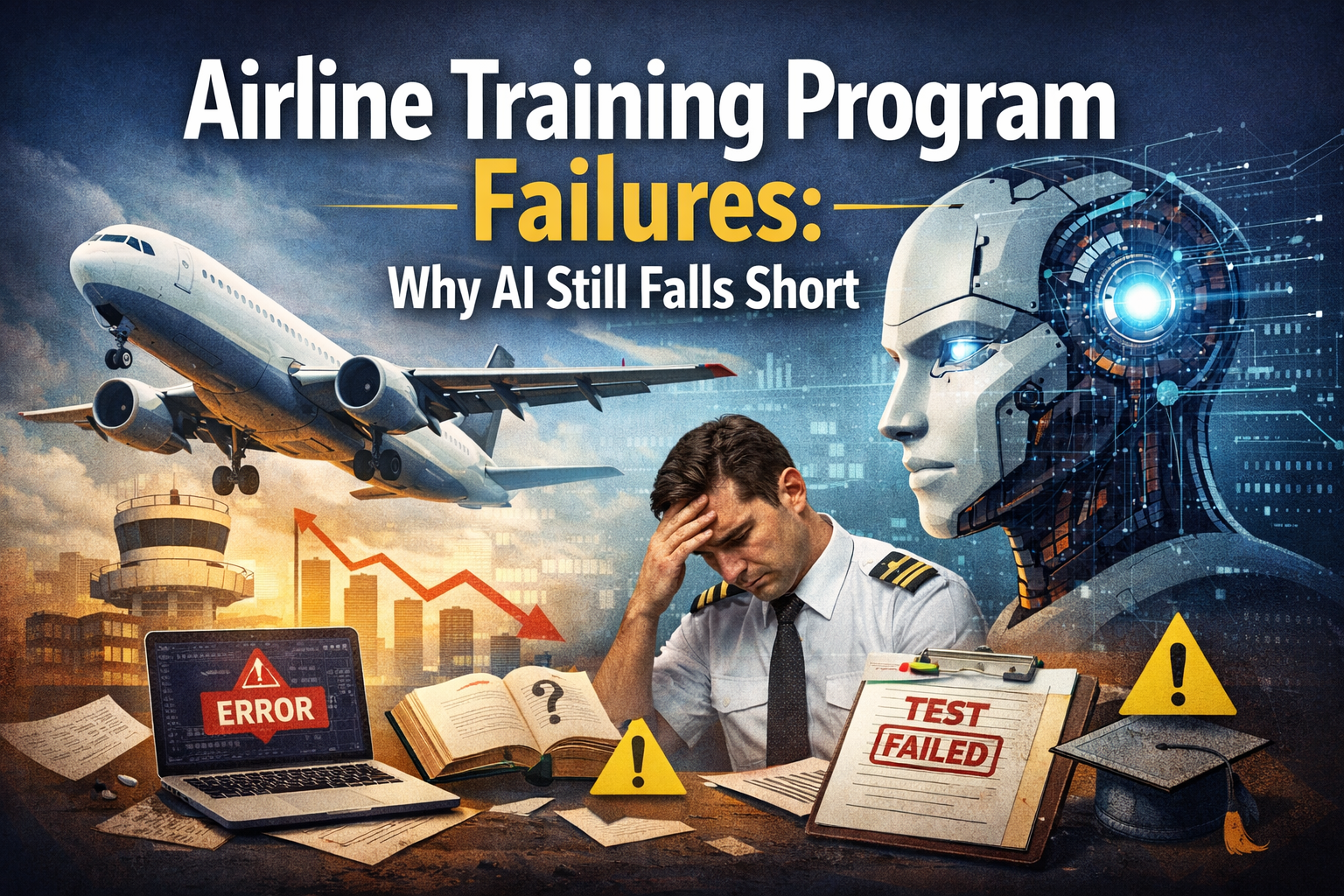
Many airlines invest in modern tools, yet their airline training program still fails to deliver consistent results. Employees complete training, but mistakes continue. Moreover, teams often struggle to apply learning in real situations. Because of this, safety risks increase and operational performance suffers.
The issue is not the absence of AI. Instead, the problem lies in how the airline training program is designed and delivered. While companies adopt AI in eLearning, they often ignore engagement, structure, and real-world application. As a result, training becomes ineffective.
Therefore, airlines must rethink their approach to build stronger training systems in 2026.
Want to see how this works in real scenarios? Request a demo
What You’ll Learn About Airline Training Systems
- Why airline training programs fail despite AI
- Common gaps in aviation training systems
- How AI in eLearning improves outcomes
- Role of microlearning modules and gamification
- Importance of the eLearning design process
Explore our portfolio to see how we have delivered real eLearning solutions across industries
Why an Airline Training Program Still Fails Despite AI
An airline training program often fails because organizations focus on tools rather than learning experience. However, technology alone cannot fix weak foundations in aviation training systems.
Common issues in airline training systems:
- Outdated and static content
- Low learner engagement
- Lack of personalization
- Poor tracking and reporting
Because of this, employees complete courses but fail to retain knowledge. As a result, performance gaps remain in the airline learning process.
Where AI Fails to Match Real Training Needs
Many companies assume AI will automatically improve their airline training program. However, without proper alignment, AI delivers limited value in aviation training frameworks.
Key gaps in aviation training programs include:
- Training not linked to real tasks
- Poor integration with workflows
- Lack of relevant content
Therefore, airlines must combine AI with strong learning strategies to improve their airline workforce training.
How AI in eLearning Improves Training Outcomes
AI in eLearning helps improve airline training systems by making learning adaptive and data-driven. Instead of static modules, AI adjusts content based on user behavior.
Key benefits for aviation training systems:
- Real-time tracking of learner performance
- Personalized learning paths
- Faster identification of skill gaps
Because of this, employees learn more effectively. As a result, the airline training process becomes more impactful.
Custom eLearning Solutions for Airline Training Program Success
Custom eLearning solutions play a key role in improving an airline training program. Generic training often fails because it does not match real-world aviation training needs.
With custom solutions in airline training systems:
- Training reflects actual workflows
- Content aligns with safety standards
- Engagement improves
Therefore, employees can apply learning directly, which strengthens the airline training framework.
Microlearning Modules in Airline Training Systems
Microlearning modules help simplify complex topics in airline training systems. Instead of long sessions, employees learn through short and focused lessons.
For example, a crew member can review a quick procedure before starting work. Because of this, retention improves. As a result, the airline training process becomes more practical and efficient.
For aviation standards, refer to the International Civil Aviation Organization: https://www.icao.int
Gamification in eLearning for Airline Training Engagement
Gamification in eLearning improves engagement in airline training systems. Traditional methods often fail due to low participation.
Gamification features in aviation training:
- Points and rewards
- Leaderboards
- Scenario-based challenges
Because of this, employees stay motivated. In addition, completion rates improve, making the airline training system more effective.
eLearning Design Process for Airline Training Systems
A structured eLearning design process is essential for building effective airline training systems. Without proper design, training lacks clarity and impact.
Steps for improving airline training frameworks
- Define learning objectives
- Create real-world scenarios
- Add interactive elements
- Continuously improve
Because of this, the airline training program becomes more aligned with operational needs.
eLearning Platform and Providers for Airline Training
An eLearning platform supports the delivery and management of airline training systems. It should offer tracking, reporting, and mobile access.
At the same time, experienced eLearning content providers ensure high-quality content for aviation training programs.
Because of this, organizations can scale their airline workforce training effectively.
You can also explore training insights from the Association for Talent Development: https://www.td.org
Common Mistakes in Airline Training Systems
Even well-funded airline training systems fail due to avoidable mistakes.
Avoid these in your airline training process:
- Long and outdated sessions
- Ignoring feedback
- Lack of updates
- Poor engagement strategies
Because of this, the airline training program loses effectiveness over time.
FAQs on Airline Training Program
1. Why does an airline training program fail despite AI?
Because of poor design, low engagement, and outdated content.
2. How does AI in eLearning improve airline training systems?
It personalizes learning and tracks performance.
3. What role do microlearning modules play in airline training?
They improve retention and usability.
4. Why use gamification in aviation training?
It increases engagement and completion rates.
5. How to choose the right training platform?
Look for tracking, flexibility, and aviation expertise.
Conclusion: Improve Your Airline Training Program
A strong airline training program requires more than AI tools. While technology helps, success depends on training design and execution.By using custom eLearning solutions, microlearning modules, gamification, and structured design, airlines can improve results. As a result, teams perform better and reduce operational risks.
Ready to Upgrade Your Airline Training System?
If your airline training program is not delivering results, now is the time to act.
Get started now by visiting our contact page.