
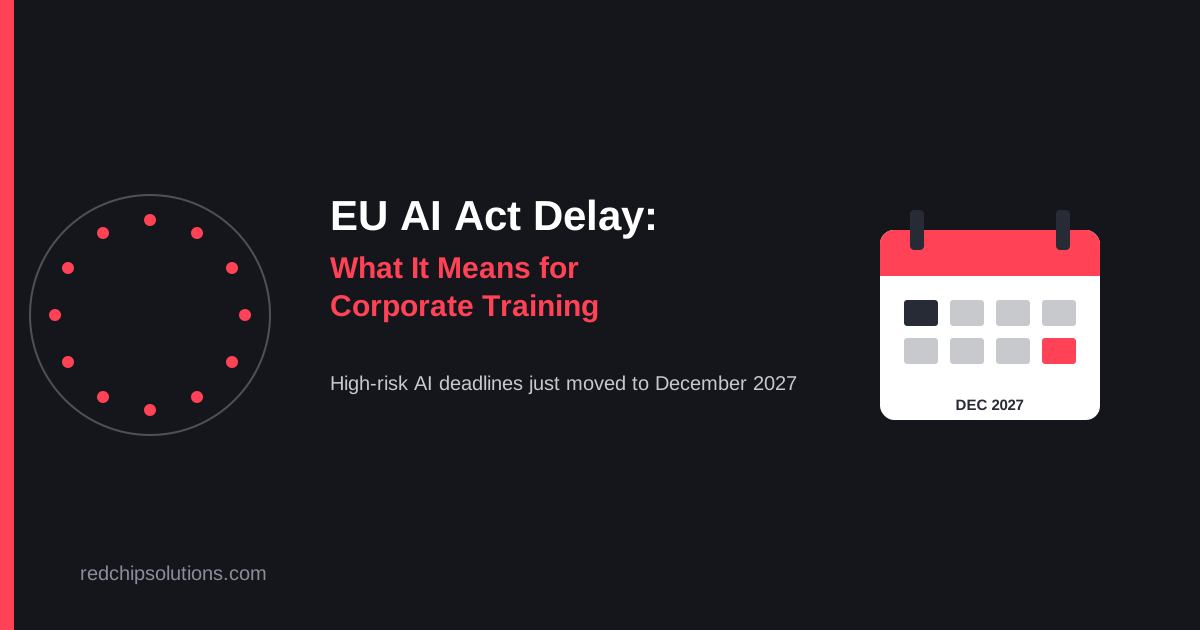
The EU AI Act delay is the reason: most L&D teams still think the EU AI Act’s high-risk obligations hit in August 2026. That deadline moved. The EU pushed it back to December 2, 2027, giving vendors and buyers of AI-powered training tools sixteen extra months to get their house in order.
This matters directly for corporate learning. AI-driven course personalization, adaptive assessments, and chatbot-based coaching inside an LMS can all qualify as high-risk AI under the Act, especially where they touch employment decisions or access to training tied to career progression. A longer runway is not the same as a cancelled obligation, and the organizations that treat it that way will be scrambling again in 2027.
What This Guide Covers
This guide explains what the EU AI Act delay actually changed and what it means for anyone buying, building, or managing AI-powered training. Here is what you will find:
- Why the EU AI Act delay matters for L&D teams
- What actually changed in the compliance timeline
- Why employment-linked AI still counts as high-risk
- The four obligations that still apply regardless of the new dates
- What this means for AI-powered course personalization
- Questions to ask your LMS vendor during the extended runway
- How to approach choosing or renewing an LMS right now
- What makes a learning platform genuinely AI Act-ready
- How Red Chip Solutions builds AI transparency into learning platforms
Why the EU AI Act Delay Matters for L&D Teams
Corporate learning has quietly become one of the more AI-heavy functions inside most organizations. Personalization engines choose what a learner sees next. Chatbots coach employees through scenarios. Automated scoring decides who passes a compliance module and who gets flagged for remediation. Any of these can influence an employment decision, which is exactly the category the EU AI Act treats as high-risk.
The delay changes the calendar, not the classification. Teams that assumed they had until 2026 now have until 2027, but teams that assumed the pressure was off entirely are misreading the update.
What the EU AI Act Delay Actually Changed
The EU AI Act delay covers several tracks, not just one date. a detailed summary of the delay from Travers Smith lays out the detail, and the European Commission’s AI Act regulatory framework page tracks the official timeline as it evolves:
- New or substantially modified high-risk systems (Annex III) — original deadline August 2026, now December 2, 2027
- AI embedded in products already covered by EU safety regulation (Annex I) — original deadline August 2027, now August 2, 2028
- Transparency labelling for AI-generated content — original deadline June 2026, now December 2, 2026
- Expanded relief for small and mid-cap companies, including simplified documentation and proportionate penalties
Employment-Linked AI Still Counts as High-Risk
Nothing about the delay reclassifies employment-related AI systems. Tools that influence training access, performance scoring, or career-track decisions stay high-risk under the Act’s original Annex III categories. Only the compliance clock moved.
The Four Obligations That Still Apply
Vendors are already building toward these requirements, delay or no delay:
- Transparency — learners must know when they are interacting with an AI system, not a human coach or a static course
- Accuracy and robustness — the model needs documented testing and ongoing monitoring, not a one-time validation
- Human oversight — someone in the organization must be able to intervene in or override an AI-driven decision
- Event logging — every AI interaction needs an auditable record that can be pulled on request
Teams already building toward these requirements for regulated-industry deployments, the same discipline behind AI model validation under GxP guidelines, are simply ahead of schedule now instead of behind it.
What This Means for AI-Powered Course Personalization
Adaptive learning paths and AI-driven content recommendations are exactly the kind of feature the Act is watching. If a personalization engine decides which employees see advanced material and which get remedial tracks, that decision loop needs the same documentation and oversight as any other high-risk system. Personalization is a genuine efficiency gain, but only when it is built with an audit trail underneath it, not bolted onto a black-box model.
Vendor Due Diligence: Questions to Ask Your LMS Provider
The extra time is best spent doing vendor due diligence before a contract renewal forces the conversation. Ask any AI-powered LMS or content platform to answer, in writing:
- Where are employee interaction and performance data physically processed and stored?
- Which AI models power personalization or scoring features, and which versions are currently live?
- Is our data excluded from any third-party model training?
- Can we export a complete, readable log of AI-driven interactions and decisions on demand?
- Is there a public transparency document describing how the AI features work?
A vendor that cannot answer these five questions today will struggle to answer them under audit later, regardless of how far the deadline has moved.
Choosing or Renewing an LMS During the EU AI Act Delay
If your organization is evaluating a new LMS or a compliance-ready LMS this year, treat AI Act readiness as a selection criterion, not an afterthought. The 2027 deadline sounds distant, but procurement cycles, data migrations, and vendor contracts often run two to three years. A platform chosen today will likely still be running when the obligations land.
Regulated industries in particular, pharma, aviation, banking, should not read the delay as permission to wait. Sector-specific regulators frequently move faster than the EU’s own general timeline, and training records are often the first thing an auditor requests.
Red Chip Solutions for AI Act-Ready Learning
Red Chip Solutions brings custom eLearning solutions, AI-powered personalization, scenario-based training, and LMS technology together with exactly this kind of scrutiny in mind. For organizations building or buying AI-driven training tools, this means documented model behaviour, exportable interaction logs, and human oversight designed in from the start rather than added after an audit finding.
Red Chip Solutions provides custom eLearning solutions along with its Redovator LMS and other learning services designed around organizational training needs, including the compliance-heavy requirements that regulated industries already work under. Explore the Red Chip Solutions Portfolio to see examples of its learning projects across different industries.
What Makes an AI-Ready Learning Platform Effective?
An effective AI Act-ready learning platform should be transparent, documented, overseen, auditable, and scalable.
Transparent AI-Ready Learning. Learners should always know when a course, recommendation, or assessment result comes from an AI system rather than a human reviewer.
Documented AI-Ready Learning. Every model powering a personalization or scoring feature should have a record of what it does, how it was tested, and when it was last updated.
Overseen AI-Ready Learning. A named person, not just a support ticket, should be able to intervene in or reverse an AI-driven training decision.
Auditable AI-Ready Learning. Interaction logs should be exportable in a readable format on request, not locked inside a vendor’s internal systems.
Scalable AI-Ready Learning. The compliance approach should hold up as new roles, regions, and AI features are added, not just at the size the organization is today.
Conclusion: EU AI Act Delay and the Future of Corporate Training
The EU AI Act delay gives organizations more time, not less responsibility. Employment-linked AI in learning platforms stays high-risk, and the four core obligations, transparency, accuracy, oversight, and logging, still apply regardless of the new dates. Manufacturers and regulated industries that treat this runway as active preparation time, rather than a reason to relax, will be the ones ready when the obligations land in December 2027. Requesting for a Demo to see how Red Chip Solutions approaches AI transparency in the Redovator LMS.