
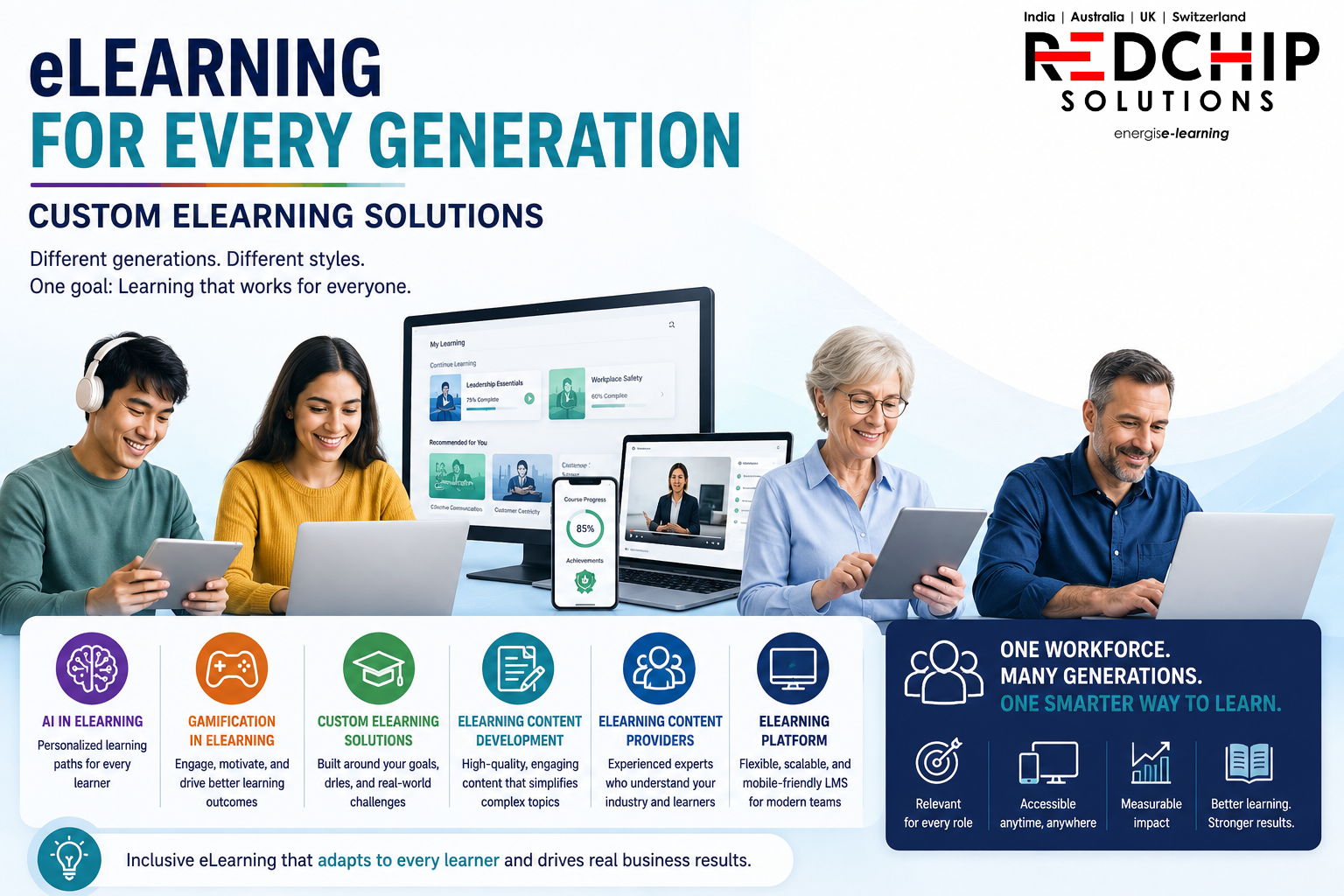
eLearning for Every Generation is becoming a key need for organizations with a mixed-age workforce. Today, many companies have employees from different age groups working side by side. As a result, one training style may not work equally well for everyone.
Some employees may prefer short videos and mobile learning. Others may want detailed guides, clear steps, or time to explore a topic on their own. Meanwhile, younger learners may enjoy interactive activities, while experienced employees may value practical examples based on real work.
However, this does not mean that companies need a separate course for every age group. Instead, effective custom eLearning solutions can provide different ways to access and use the same learning content.
For example, AI in eLearning, gamification in eLearning, strong eLearning content development, and a flexible eLearning platform can help create learning that feels useful to a wider range of employees.
Most importantly, the goal is not to design training around stereotypes about age. Rather, the goal is to design around different needs, skills, experience levels, work habits, and learning preferences.
If your organization needs learning that works across different employee groups, Requesting for a Demo can be the first step toward discussing your requirements with Red Chip Solutions.
What You Will Find in This eLearning for Every Generation Guide
This guide looks at practical ways to make digital learning more inclusive and useful, including:
- Different learner needs in a mixed-age workforce
- How to design flexible eLearning content
- The role of AI in eLearning
- Using gamification in eLearning
- Mobile and self-paced learning
- Accessibility and simple course design
- The role of an eLearning platform
- Why custom eLearning solutions can improve learning
- How to choose the right eLearning content providers
Why eLearning for Every Generation Matters
eLearning for Every Generation starts with one simple idea: employees do not all learn in the same way.
For example, an employee who has spent 20 years in an industry may already understand the basic process. Therefore, forcing that person through long introductory lessons can make training feel slow.
On the other hand, a new employee may need more context, examples, and guided practice before they can perform the same task with confidence.
Similarly, some employees may be comfortable with new technology, while others may need a simple introduction before they begin.
Therefore, good digital learning should offer choice without creating confusion.
The CAST Universal Design for Learning Guidelines also support the idea of offering multiple ways for learners to engage with content, understand information, and demonstrate what they know. (CAST)
As a result, organizations can move away from the idea of designing for a specific “generation” and instead focus on learner variability.
eLearning for Every Generation Needs Flexible Content
Flexible eLearning content makes eLearning for Every Generation more practical because learners can approach the same topic in different ways.
For instance, a compliance course could include:
- A short video introduction
- A written summary
- An interactive scenario
- A process diagram
- A downloadable reference guide
- A short knowledge check
- A detailed case study
Consequently, learners are not forced to depend on one format.
Someone who prefers video can watch the explanation. Meanwhile, another learner can read the key points and continue at their own pace.
Furthermore, eLearning content development should focus on clarity rather than simply adding more media.
A course with ten different media types is not automatically better. Instead, every element should have a clear purpose.
AI in eLearning for Personalized Learning
AI in eLearning can make eLearning for Every Generation more responsive by helping organizations deliver learning based on individual needs.
For example, AI can support:
- Personalized learning paths
- Content recommendations
- Knowledge-gap analysis
- Adaptive questions
- Learning reminders
- Practice activities
- Instant feedback
Suppose an experienced employee already understands a basic concept. Instead of spending a long time on it, the learning experience could direct that person toward a practical scenario.
Meanwhile, a new learner could receive additional examples before moving forward.
However, AI should support the learner rather than replace good instructional design.
Therefore, organizations should first define the learning goal and then decide where AI in eLearning can add real value.
Gamification in eLearning for Different Learner Needs
Gamification in eLearning can make eLearning for Every Generation more engaging when it is connected to the learning goal.
For example, a sales course could use a customer simulation. Learners could make decisions, receive feedback, and see how their choices affect the outcome.
Likewise, a safety course could ask learners to identify risks in a workplace scene.
Instead of simply reading a list of safety rules, employees can practise applying those rules.
However, gamification does not always mean points, badges, or leaderboards.
It can also include:
- Challenges
- Progress indicators
- Simulations
- Branching scenarios
- Decision-based activities
- Instant feedback
- Real-world missions
As a result, gamification in eLearning can support different levels of experience while keeping the learning focused on practical skills.
Custom eLearning Solutions for a Mixed-Age Workforce
Custom eLearning solutions allow organizations to build training around their actual workforce rather than forcing employees into a generic course.
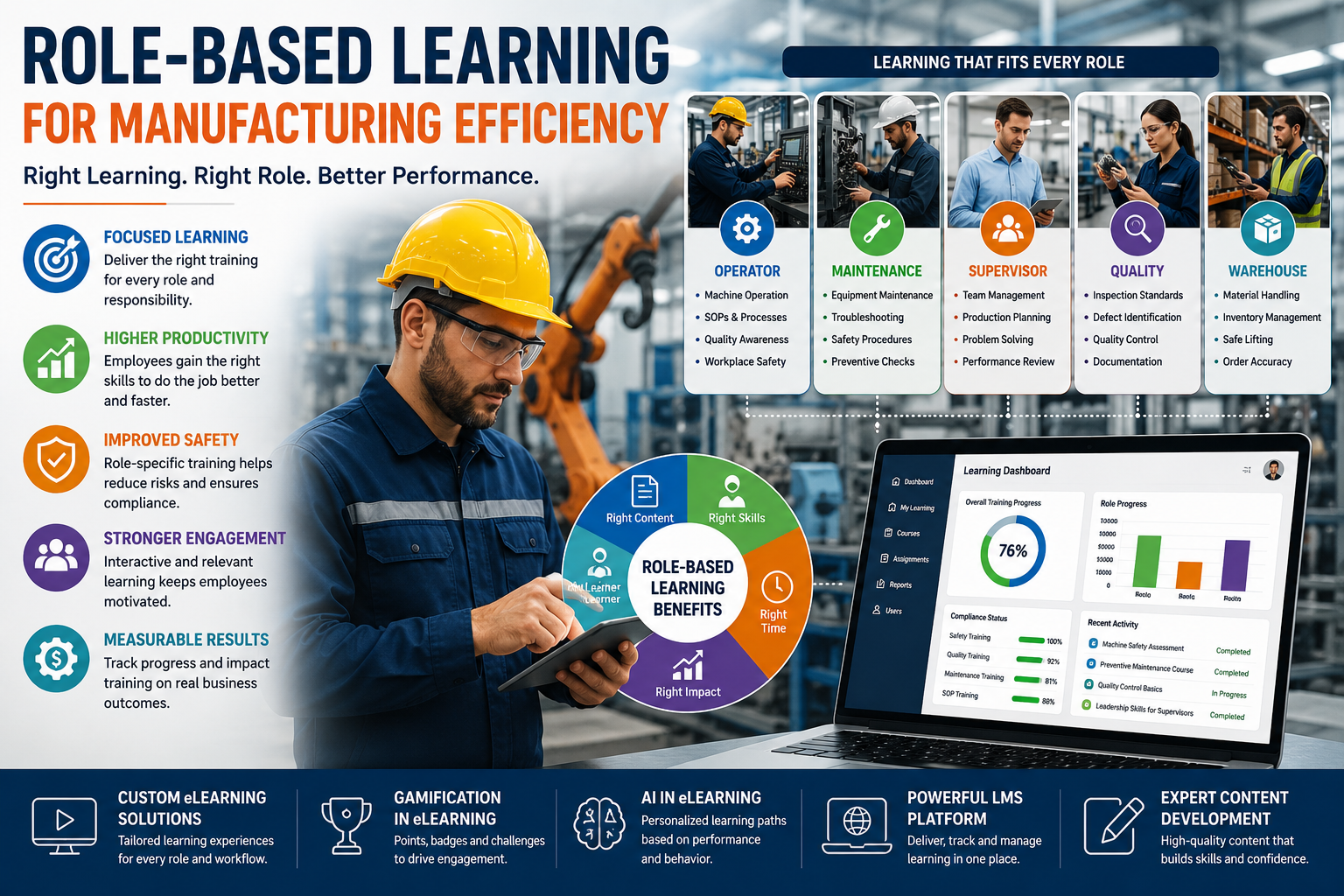
For example, a manufacturing company may have experienced operators, new workers, supervisors, engineers, and managers.
Clearly, their training needs will not be identical.
Therefore, a custom course could provide different learning paths based on role and experience.
A new employee might receive:
- Basic concepts
- Process demonstrations
- Guided practice
- Knowledge checks
- Job-based scenarios
An experienced employee, however, might receive:
- A short refresher
- Updated process changes
- Advanced scenarios
- A final competency check
This approach saves time while keeping learning relevant.
Moreover, custom eLearning solutions can be designed to match company language, workflows, policies, systems, and brand standards.
eLearning Content Development Should Focus on Real Work
eLearning content development becomes more effective when the content reflects what employees actually do.
For example, instead of creating a course called “Communication Skills,” consider a course built around real situations:
- Handling a difficult customer
- Giving feedback to a colleague
- Joining a virtual meeting
- Managing a workplace conflict
- Speaking with a manager
- Explaining a technical issue
As a result, employees can see the value of the course immediately.
Similarly, examples should reflect different levels of experience.
A new employee may need step-by-step guidance. An experienced employee may benefit more from a complex scenario that tests judgment.
Therefore, practical context can make eLearning for Every Generation more useful without making the course longer.
Simple Design Makes eLearning for Every Generation Stronger
Simple design is another important part of eLearning for Every Generation.
Modern courses do not need to be packed with animations, text, and effects.
Instead, learners should be able to quickly understand:
- Where they are
- What they need to learn
- What they need to do
- What happens next
Furthermore, readable text, clear buttons, useful visuals, captions, and simple navigation can reduce barriers.
Therefore, accessibility is not simply a technical requirement. It can also improve the learning experience for everyone.
Mobile Learning Supports eLearning for Every Generation
Mobile learning can make eLearning for Every Generation easier to access because employees can learn when and where it suits their work.
For example, a learner may complete a five-minute module during a break. Later, that employee can return to a longer scenario on a laptop.
Similarly, mobile-friendly learning can support distributed teams, field workers, sales teams, and employees who do not spend the entire day at a desk.
However, mobile learning should not simply shrink a desktop course onto a phone.
Instead, content should be designed for smaller screens from the start.
Short sections, simple navigation, clear buttons, captions, and focused activities can make the experience much better.
eLearning Platform Features That Support Different Learners
An eLearning platform plays an important role in making eLearning for Every Generation easier to manage.
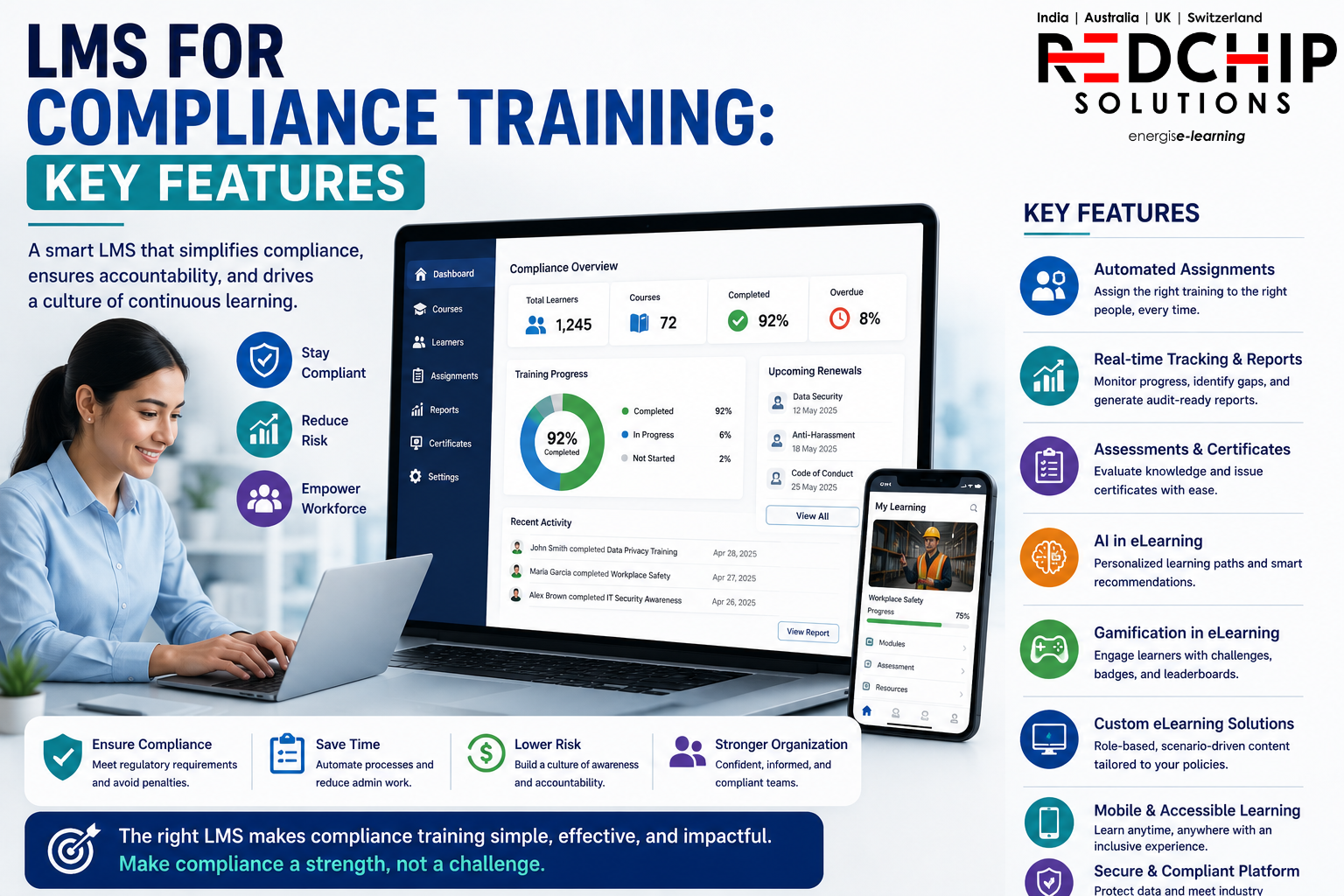
A strong LMS can help organizations provide:
- Role-based learning
- Personalized learning paths
- Mobile access
- Assessments
- Progress tracking
- Course recommendations
- Learning dashboards
- Certificates
- Reports
- Content updates
Moreover, managers can use learning data to understand where employees may need additional support.
For example, if a large number of learners struggle with one assessment, the issue may not be the employees. Instead, the content may need to be clearer.
Therefore, LMS data should be used to improve the learning experience rather than simply measure completion.
Choosing eLearning Content Providers for Multi-Generational Learning
eLearning content providers can help organizations turn these ideas into practical learning experiences.
However, choosing a provider should involve more than checking whether they can create attractive courses.
Organizations should also ask:
- Can they create role-based learning?
- Can they design for different experience levels?
- Can they support AI in eLearning?
- Can they build gamified learning?
- Can they create custom eLearning solutions?
- Can they work with existing LMS platforms?
- Can they support accessibility?
- Can they create simulations and scenarios?
- Can they measure learning outcomes?
Furthermore, the provider should be able to work with subject matter experts and turn complex information into clear learning.
That combination of instructional design, technology, content, and business understanding is what makes a long-term learning partner valuable.
How to Build eLearning for Every Generation Without Stereotypes
eLearning for Every Generation should never assume that every person in an age group learns in exactly the same way.
For example, it would be a mistake to assume that every younger employee wants gamification or that every older employee prefers classroom training.
People are different.
Instead, organizations should consider:
- Job role
- Experience
- Digital confidence
- Accessibility needs
- Language
- Previous knowledge
- Learning goals
- Work environment
- Available technology
Consequently, personalization should be based on learner needs rather than age alone.
This approach creates a more respectful and useful learning environment.
Red Chip Solutions: Custom eLearning Solutions for Modern Workforces
Red Chip Solutions brings together custom eLearning solutions, eLearning content development, AI in eLearning, gamification in eLearning, and LMS expertise to create modern digital learning experiences.
The company can support organizations that need more than off-the-shelf courses. Instead, its approach focuses on building learning around business goals, employee roles, industry needs, and real workplace situations.
Moreover, Red Chip Solutions can help organizations create interactive learning that works across different employee groups and experience levels.
Its goal is to position itself as a top eLearning vendor for modern organizations, combining instructional design with technology to create learning that is practical, engaging, and scalable.
You can Explore Red Chip Solutions Portfolio to see examples of its eLearning work.
Conclusion: Making eLearning Work for Everyone
eLearning for Every Generation is not about creating separate courses for different age groups. Instead, it is about creating flexible learning that respects the fact that employees have different skills, experiences, preferences, and needs.
Therefore, organizations should focus on simple design, relevant examples, accessible content, personalization, and practical activities.
At the same time, AI in eLearning can support personalized learning, while gamification in eLearning can make practice more engaging. Furthermore, custom eLearning solutions can connect learning directly to business processes.
Strong eLearning content development and the right eLearning content providers can then turn these ideas into practical courses. Finally, a capable eLearning platform can deliver, track, and improve the learning experience at scale.
For organizations looking to build learning that works across a diverse workforce, Red Chip Solutions offers a combination of custom eLearning solutions, AI in eLearning, gamification, content development, and LMS capabilities.
Ready to create learning that speaks to every learner? Requesting for a Demo and discuss your organization’s eLearning goals with Red Chip Solutions.