
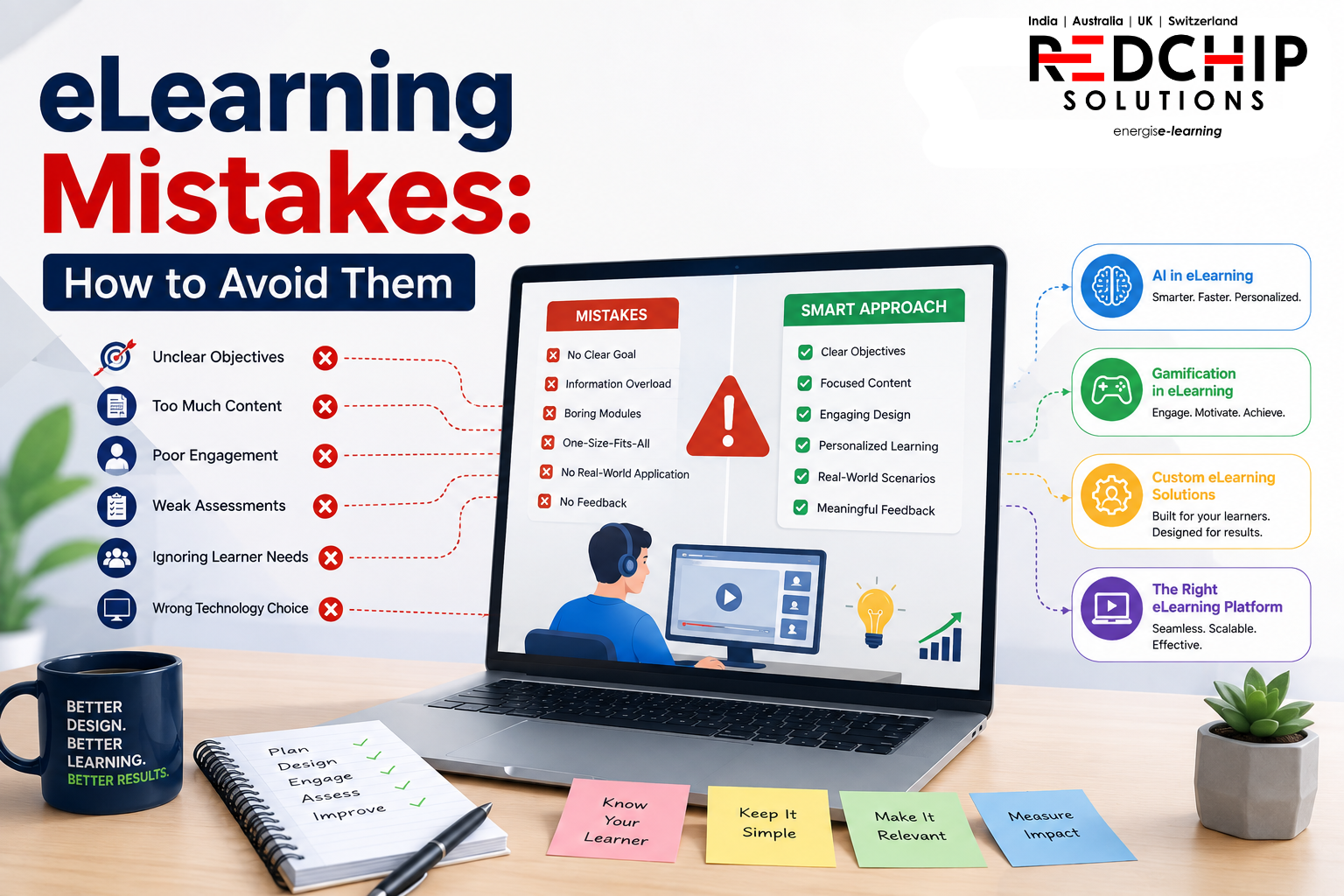
Common eLearning mistakes can reduce learner engagement, slow course completion, and make training less useful. The right custom eLearning solutions, gamification in eLearning, AI in eLearning, eLearning content development, eLearning content providers, and an effective eLearning platform can help organizations create learning that is clear, useful, and easy to apply.
For many companies, the issue is not the lack of training content. Instead, the real problem is how that content is planned, designed, delivered, and measured. A course may look modern but still fail to change learner behavior.
Explore how Red Chip Solutions can help you plan and build more effective digital learning experiences. Requesting for a Demo
What You Will Learn
- The most common eLearning mistakes businesses make
- How to improve course design and learner engagement
- Where AI and gamification can add real value
- How custom eLearning solutions can solve specific training needs
- How to select the right eLearning content provider and platform
- Ways to improve learning results without adding unnecessary complexity
1. eLearning Mistakes Start With Unclear Learning Goals
One of the most common eLearning mistakes is starting course development before defining what learners need to achieve.
A training team may collect a large amount of information from subject matter experts. However, more content does not always mean better learning. Learners need a clear path from the problem to the expected action.
Therefore, begin with a simple question:
“What should the learner be able to do after completing this course?”
For example, instead of saying “Employees will understand cybersecurity,” a better goal could be “Employees will identify common phishing attempts and report them correctly.”
This small change can improve the whole design.
Better Planning Prevents eLearning Mistakes
Before development begins, define:
- Business goals
- Learner needs
- Learning objectives
- Required skills
- Assessment methods
- Expected workplace behavior
ATD also highlights the importance of intentional instructional design, measurable objectives, learner needs, and assessments when developing effective eLearning. ATD
As a result, good planning can prevent major changes later in the project.
2. Poor Content Design Is a Major eLearning Mistake
Another common eLearning mistake is trying to put everything into one course.
Long paragraphs, crowded screens, complex charts, and too many facts can quickly overwhelm learners. Instead, content should be broken into smaller and useful sections.
For instance, a compliance course could use:
- Short videos
- Simple examples
- Workplace scenarios
- Quick questions
- Knowledge checks
- Short simulations
- Downloadable job aids
This approach makes learning easier to follow.
Moreover, eLearning content development should focus on what learners need at the point of work. A warehouse worker, sales employee, nurse, and software engineer may all need very different learning experiences.
That is where custom eLearning solutions become useful. Rather than forcing every learner into the same generic course, custom content can reflect the role, industry, workflow, and business goal.
3. Lack of Engagement Makes eLearning Mistakes Worse
Low engagement is often linked to another common eLearning mistake: treating digital learning like a digital textbook.
Learners should not only read and click “Next.” They should have chances to think, choose, practice, and receive feedback.
Use Gamification in eLearning With a Purpose
Gamification in eLearning can turn passive training into an active experience.
For example, a cybersecurity course could ask learners to:
- Review an email.
- Identify suspicious signs.
- Choose an action.
- Receive instant feedback.
- Earn points for correct decisions.
- Move to a more difficult challenge.
However, badges and points alone do not create good learning. The game elements should support the learning goal.
Therefore, use challenges, scores, levels, rewards, and scenarios only when they help learners practice the required skill.
4. Ignoring AI in eLearning Can Limit Personalization
Another growing eLearning mistake is treating every learner in exactly the same way.
Employees have different skill levels, job roles, learning speeds, and knowledge gaps. AI in eLearning can help address some of these differences.
For example, AI can support:
- Personalized learning paths
- Content recommendations
- Automated feedback
- Question generation
- Knowledge-gap analysis
- Learner support
- Adaptive assessments
Instead of giving every employee the same sequence, an eLearning platform can use learner data to recommend relevant content.
Still, AI should not replace instructional design. Human review remains important, especially for technical, regulated, or sensitive training.
The best approach is to combine AI with strong instructional planning, expert review, and clear business goals.
5. Choosing Generic Content Can Create More eLearning Mistakes
Generic content may appear faster and cheaper at first. Yet it can become ineffective when it does not match the learner’s real work.
A banking employee may need banking examples. A pharmaceutical employee may need GMP scenarios. An airline employee may need safety-based decision practice.
This is why choosing experienced eLearning content providers matters.
A capable provider should understand more than authoring tools. It should be able to connect:
Business need → Learning goal → Content → Interaction → Assessment → Measurement
For organizations that need tailored learning, custom eLearning solutions can provide greater control over the learner experience.
See examples of how digital learning solutions have been designed for different business and training needs. Explore Red Chip Solutions Portfolio
6. A Weak eLearning Platform Can Reduce Training Impact
Even excellent content can struggle when the eLearning platform is difficult to use.
Learners should be able to find courses, track progress, complete assessments, and access resources without confusion.
A good platform should support features such as:
- Simple navigation
- Progress tracking
- Mobile access
- Course completion reports
- Assessments
- Certificates
- Learner groups
- Automated reminders
- Training dashboards
Furthermore, accessibility should be considered from the start. The W3C Web Accessibility Initiative provides the Web Content Accessibility Guidelines as a key reference for making digital content more accessible. W3C Web Accessibility Guidelines
Thus, platform selection should be based on learner and business needs rather than simply choosing the platform with the longest feature list.
7. Forgetting Assessments Is a Serious eLearning Mistake
Another eLearning mistake is measuring completion instead of learning.
A learner completing a 30-minute course does not prove that the learner can apply the knowledge.
Instead, assessments should test the actual skill.
For example:
Weak approach:
“What is phishing?”
Better approach:
“You receive this email from an unknown sender. What should you do next?”
The second question tests decision-making rather than simple memory.
Similarly, scenario-based assessments can show whether employees can apply policies and processes in realistic situations.
Therefore, assessments should match the learning objectives established at the beginning of the project.
8. Avoiding These eLearning Mistakes With a Better Process
The easiest way to reduce eLearning mistakes is to build a clear process before development begins.
A practical process looks like this:
1. Identify the business problem
First, understand why training is needed.
2. Define the learner
Next, identify the learner’s role, experience, needs, and challenges.
3. Set measurable objectives
Then decide what learners should know or do.
4. Select the right learning method
Use video, scenarios, simulations, gamification, microlearning, or assessments where they fit.
5. Develop the content
Create simple and focused learning material.
6. Add technology carefully
Use AI, gamification, analytics, and an LMS when they improve the learning experience.
7. Test with real users
Before launch, collect feedback from representative learners.
8. Measure results
Finally, track completion, assessment scores, application, and business impact.
This process helps teams avoid spending money on features that look impressive but do not solve the actual training problem.
How Red Chip Solutions Helps Organizations Avoid eLearning Mistakes
For organizations looking for a custom eLearning solutions partner, Red Chip Solutions takes a solution-focused approach rather than treating every project as a standard course build.
This can be especially useful when training needs to support different industries, job roles, locations, or learner groups.
A strong eLearning project should not simply look modern. It should make learning easier, support better decisions, and help employees perform their jobs with greater confidence.
That is the difference between adding technology and creating a useful learning experience.
Conclusion: Avoid eLearning Mistakes With Smarter Learning Design
eLearning mistakes are often caused by poor planning, too much content, weak assessments, limited interaction, or the wrong technology. Fortunately, these problems can be avoided with a learner-first approach.
By combining custom eLearning solutions, gamification in eLearning, AI in eLearning, strong eLearning content development, experienced eLearning content providers, and the right eLearning platform, organizations can create training that is more engaging and useful.
Most importantly, technology should support the learning goal rather than become the goal itself.
Ready to improve your next eLearning project? Requesting for a Demo and discuss your training goals with the Red Chip Solutions team.