
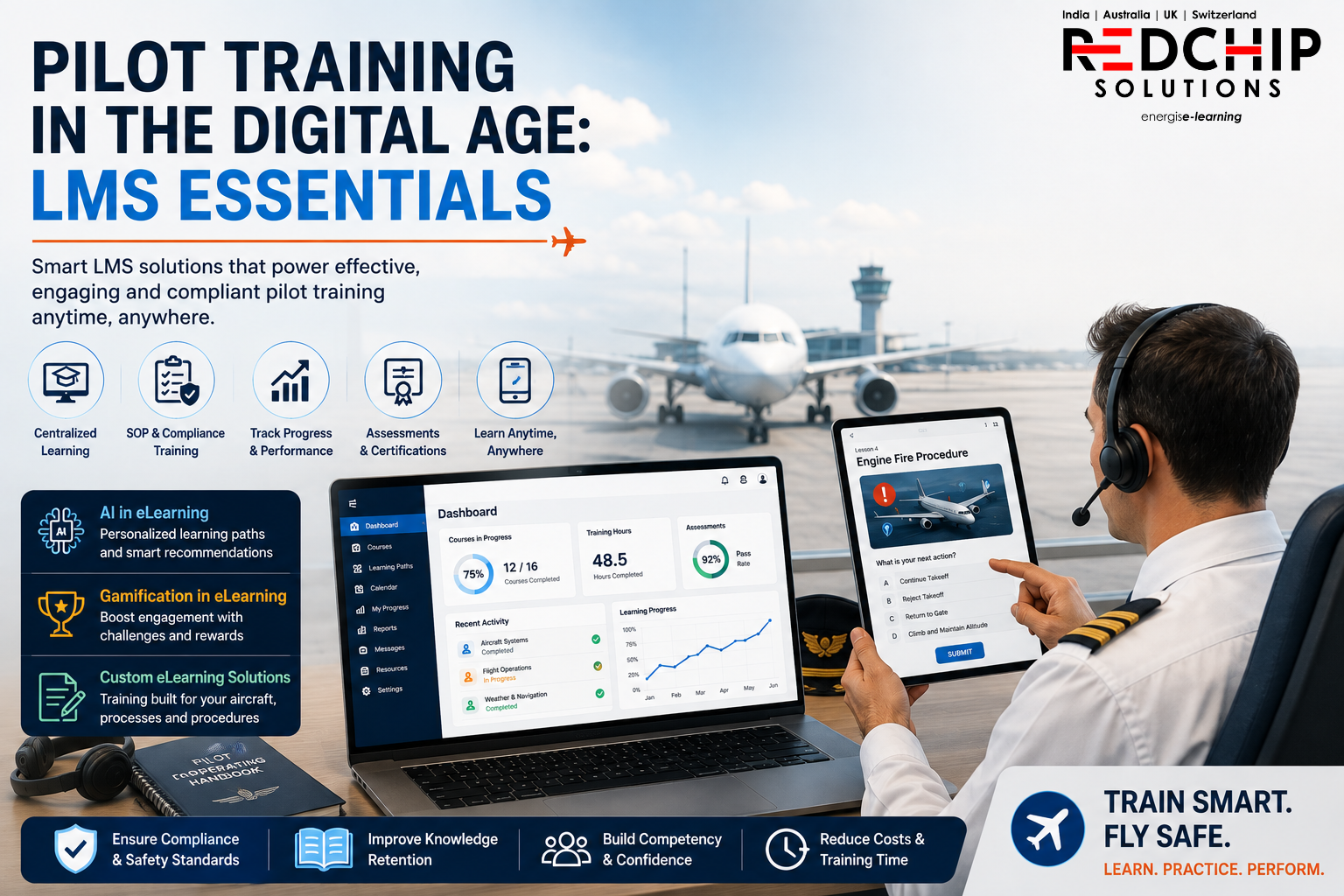
Pilot Training in the Digital Age is changing how airlines, flight schools, and aviation training teams prepare pilots for real-world operations. Modern pilot training is no longer limited to classroom lessons, manuals, and simulator sessions. Instead, a well-planned LMS can bring courses, assessments, learning records, and performance data into one place.
At the same time, aviation teams need training that is accurate, easy to update, and closely linked to job performance. Therefore, organizations are looking at custom eLearning solutions, AI in eLearning, gamification in eLearning, and modern eLearning platforms to make learning more flexible.
For aviation training teams, the goal is not simply to move existing content online. Rather, the goal is to create a learning experience that helps pilots understand procedures, practice decisions, identify knowledge gaps, and stay ready for changing operational needs.
If you are planning to modernize your aviation training program, connect with Red Chip Solutions to discuss your learning requirements.
What This Guide Covers
This guide explores the key LMS features that can strengthen Pilot Training in the Digital Age, including:
- Centralized pilot training management
- Competency-based learning
- AI in eLearning and personalized learning
- Gamification in eLearning
- Scenario-based and simulation-supported learning
- eLearning content development
- Training records and reporting
- Mobile and flexible learning
- Choosing the right eLearning platform
- The role of eLearning content providers
- How custom eLearning solutions can support aviation organizations
Pilot Training in the Digital Age: LMS for Modern Pilot Learning
A modern LMS can give aviation organizations one central place to manage digital learning. Instead of keeping training information across spreadsheets, emails, documents, and separate systems, training managers can organize learning through one platform.
For example, an LMS can support:
- Pilot onboarding
- Recurrent training
- Safety training
- SOP learning
- Knowledge checks
- Compliance courses
- Assessments
- Training records
- Learning progress
- Completion reports
Moreover, an LMS can help training teams see which courses have been completed and where additional support may be needed.
Therefore, an LMS should support the training strategy rather than simply act as a content library.
Pilot Training in the Digital Age: Custom eLearning Solutions
Custom eLearning solutions can make Pilot Training in the Digital Age more relevant to a specific airline, fleet, aircraft type, or training requirement.
Generic courses can provide useful knowledge. However, aviation organizations often have their own SOPs, operating processes, safety rules, aircraft systems, and internal standards.
That is where custom learning becomes valuable.
A custom aviation course can include:
- Airline-specific procedures
- Aircraft system training
- Real operational scenarios
- Interactive cockpit visuals
- Decision-making exercises
- Safety procedures
- Emergency response situations
- Role-based assessments
Furthermore, custom eLearning solutions allow training teams to update content when procedures change.
This is especially important in aviation because training content must stay aligned with current operational requirements and approved procedures.
Pilot Training in the Digital Age: AI in eLearning
AI in eLearning can add another layer of personalization to modern pilot training.
Pilots do not all have the same learning needs. One learner may need more practice with technical systems, while another may need additional support with procedures or decision-making.
Therefore, AI can help analyze learning activity and identify areas where additional practice may be useful.
For example, an LMS could use learning data to support:
- Personalized learning paths
- Targeted revision
- Knowledge-gap identification
- Adaptive assessments
- Recommended learning content
- Performance insights
However, AI should support instructors rather than replace aviation expertise. Training teams still need subject matter experts to review learning content, scenarios, assessments, and recommendations.
As a result, the strongest approach combines AI in eLearning with sound instructional design and aviation expertise.
Pilot Training in the Digital Age: Gamification in eLearning
Gamification in eLearning can make repetitive training more engaging without reducing the seriousness of aviation learning.
For example, a course could turn a learning activity into a mission where pilots must identify risks, make decisions, and select the correct action. Points, progress indicators, badges, and challenges can then provide feedback.
More importantly, gamification should have a learning purpose.
Good gamification in eLearning can help pilots:
- Practice decisions
- Review procedures
- Test their knowledge
- Receive immediate feedback
- Track progress
- Repeat difficult activities
In contrast, adding points or badges without a clear learning goal may add little value.
Therefore, gamification should be designed around the skills the learner needs to demonstrate.
Pilot Training in the Digital Age: eLearning Content Development
Strong eLearning content development is essential because aviation topics can be technical and detailed.
Simply converting a training manual into slides does not create effective digital learning. Instead, the content should be reorganized into short lessons, useful visuals, interactions, scenarios, and assessments.
For instance, a lesson on an aircraft system could include an interactive diagram. A safety lesson could use a branching scenario. A procedure lesson could use a step-by-step interaction.
Consequently, learners spend less time reading large blocks of text and more time applying what they have learned.
The FAA Pilot Training resources provide a wide range of pilot study materials, handbooks, training resources, and training information.
Pilot Training in the Digital Age: Choosing eLearning Content Providers
Choosing the right eLearning content providers is important when building aviation training at scale.
A capable provider should understand more than course design. They should also understand instructional design, LMS delivery, interactive learning, assessments, accessibility, and the need for subject matter review.
Before selecting an eLearning content provider, ask:
- Can they create custom aviation learning?
- Can they work with your subject matter experts?
- Can they develop scenario-based training?
- Can their courses work with your LMS?
- Can they support updates and revisions?
- Can they provide reporting-ready content?
- Can they build responsive and mobile-friendly courses?
Furthermore, look for a provider that focuses on learning outcomes rather than simply producing attractive screens.
Scenario-Based Learning for Better Pilot Decisions
Scenario-based learning is one of the most useful approaches for Pilot Training in the Digital Age.
Instead of asking a learner to remember a rule, the course can present a realistic situation and ask:
What would you do next?
The learner then selects an action and receives feedback.
This approach can support decision-making, risk awareness, communication, and procedural thinking.
Therefore, scenario-based eLearning can complement broader aviation training programs when it is designed around the right competencies.
How Red Chip Solutions Supports Modern Pilot Training
Red Chip Solutions approaches Pilot Training in the Digital Age by combining instructional design, technology, interactivity, and business needs.
The company has been working in the eLearning space since 2007 and provides custom eLearning solutions, custom content development, scenario-based learning, games and gamification, localization, and LMS solutions. (Red Chip Solutions)
Its approach can support aviation organizations that need:
- Interactive pilot training
- Scenario-based learning
- Gamification in eLearning
- AI in eLearning
- Custom learning paths
- eLearning content development
- LMS-ready courses
- Mobile learning
- Assessment and knowledge checks
- Training localization
Rather than relying only on off-the-shelf content, Red Chip Solutions focuses on creating learning experiences around the organization’s actual requirements.
Building a Future-Ready Pilot Training Strategy
The future of Pilot Training in the Digital Age is not about replacing instructors or practical training with digital courses. Instead, digital learning can strengthen the overall training journey.
A strong program can combine:
Instructor-led training + simulator practice + LMS learning + scenario-based activities + assessments + performance data
This blended approach can help learners prepare before classroom or simulator sessions. In addition, it gives them opportunities to review important topics afterward.
Therefore, the LMS becomes part of a wider learning ecosystem rather than a standalone training tool.
Conclusion: Making Pilot Training More Digital and Effective
Pilot Training in the Digital Age requires more than uploading manuals to an LMS. Effective aviation learning combines clear instructional design, useful technology, realistic scenarios, strong assessments, and measurable learning outcomes.
With custom eLearning solutions, organizations can create training that reflects their own operations. Meanwhile, AI in eLearning can support personalization, and gamification in eLearning can improve engagement when used with purpose. Strong eLearning content development then turns complex aviation topics into clear digital experiences.
Finally, the right eLearning platform and experienced eLearning content providers can bring these elements together into a scalable training program.
For organizations looking to modernize aviation learning, Red Chip Solutions offers a practical combination of custom eLearning, interactive learning, gamification, AI-enabled learning, and LMS solutions. (Red Chip Solutions)
Ready to modernize your pilot training program? Requesting for a Demo and discuss your aviation learning goals with the Red Chip Solutions team.