
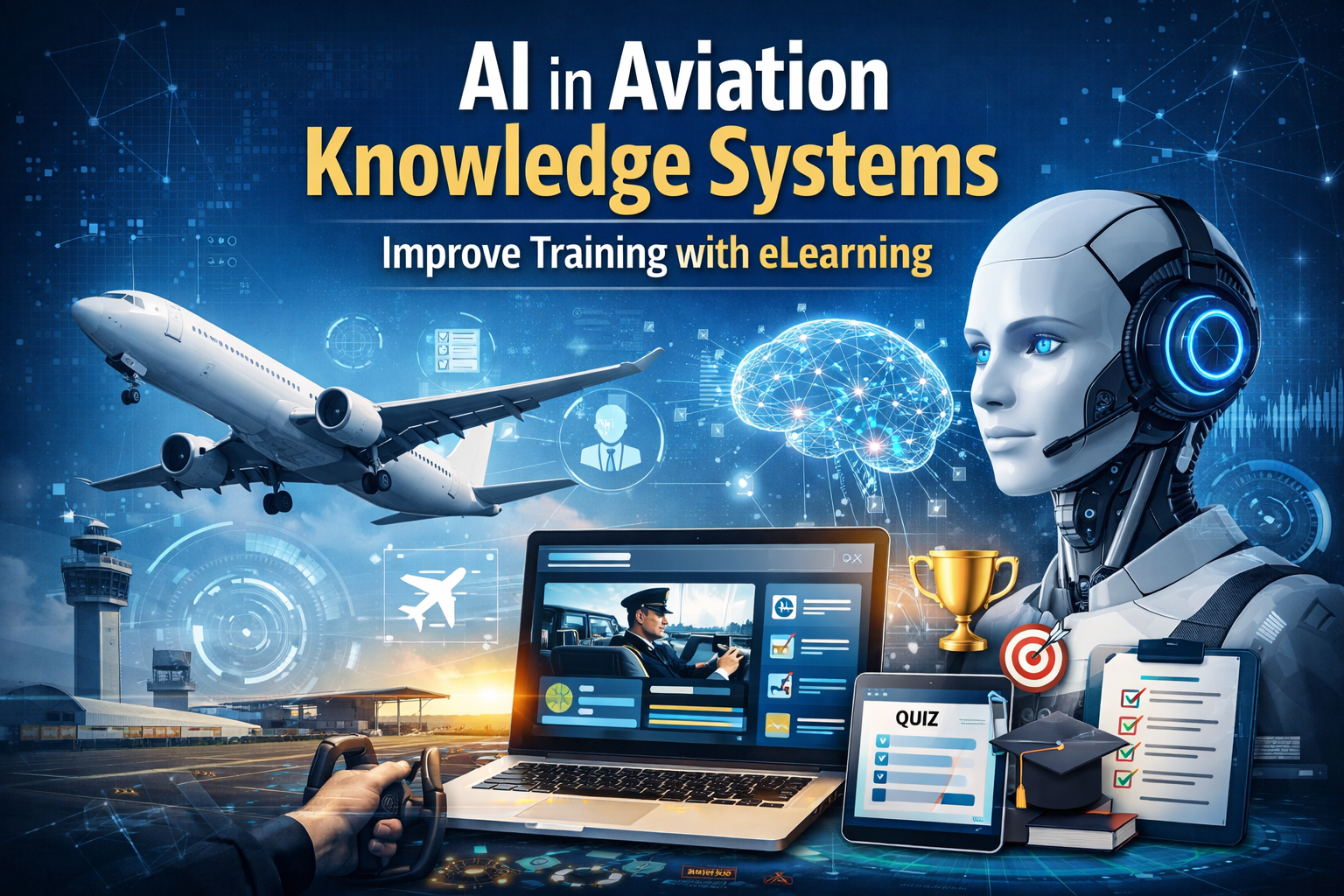
AI in aviation knowledge systems is becoming essential as aviation teams operate in fast-paced environments where accuracy, safety, and quick decisions matter every day. However, many organizations still rely on outdated systems where knowledge is scattered across manuals, documents, and disconnected platforms. Because of this, employees often struggle to find the right information at the right time, which slows down operations and increases the chances of errors.
To solve this challenge, companies are now using AI in eLearning along with custom eLearning solutions to make knowledge more structured and accessible. As a result, teams can access relevant information faster, improve performance, and maintain compliance more effectively across operations.
If you want to see how this works in real-world aviation training setups, you can request a demo through our contact page and understand how these systems are implemented.
What this blog covers
- Role of AI in aviation knowledge systems
- Use of microlearning modules in training
- How gamification improves engagement
- Importance of the eLearning design process
- Choosing the right eLearning platform
- Working with eLearning content providers
To explore how these solutions are applied across industries, you can also check our portfolio of custom eLearning solutions.
AI in Aviation Knowledge Systems Improves Operational Efficiency
AI-powered aviation knowledge systems help organizations manage large volumes of operational data such as SOPs, manuals, and safety procedures more effectively. Earlier, employees had to spend a lot of time searching for the right information. However, modern systems now organize and deliver relevant content instantly based on roles and tasks.
Because of this, employees can focus more on execution instead of searching. In addition, real-time updates ensure that all teams are working with the most current information, which improves both safety and consistency. As a result, decision-making becomes faster and more reliable across operations.
Organizations often align their processes with global aviation standards set by the International Civil Aviation Organization.
Microlearning Modules in Aviation Knowledge Systems with AI
Microlearning modules play a key role in aviation knowledge systems with AI, especially in fast-paced work environments. Instead of long training sessions, employees receive short and focused lessons that are easier to consume and apply during daily tasks.
For example, a technician can quickly review a short module before performing a maintenance task. Because of this, learning becomes more practical and immediately useful. At the same time, AI tracks completion rates and performance patterns, helping organizations identify gaps and improve training continuously.
As a result, microlearning improves retention while also supporting real-time performance on the job.
Gamification in eLearning within AI-Driven Aviation Training Systems
Gamification in eLearning within AI-driven aviation training systems helps solve the problem of low engagement. Traditional training often feels repetitive, which leads to lower participation. However, adding interactive elements changes how employees experience learning.
By using points, badges, and scenario-based challenges, training becomes more engaging and competitive. As a result, employees are more likely to complete their modules and stay involved in the learning process. In addition, practical scenarios help them apply knowledge in real situations.
Therefore, gamification not only improves engagement but also strengthens learning outcomes.
AI in eLearning for Personalized Aviation Training
AI in eLearning allows aviation organizations to deliver personalized learning experiences based on individual needs. Not every employee requires the same training, and a standard approach often leads to inefficiencies.
AI systems analyze user behavior, past performance, and learning patterns to recommend relevant content. For instance, new employees receive foundational training, while experienced staff can access advanced modules tailored to their roles. Because of this, employees focus only on what is important.
As a result, training becomes more efficient, targeted, and impactful across teams.
eLearning Design Process in Aviation Knowledge Systems
The eLearning design process in aviation knowledge systems ensures that training content is structured, practical, and aligned with business goals. Without a clear process, training programs can become inconsistent and difficult to follow.
The process begins with defining learning objectives. Then, eLearning content development focuses on real-world scenarios that employees face in their roles. After that, interactive elements such as simulations and assessments are added to improve engagement.
Finally, AI-driven insights help refine content over time. Because of this, organizations can continuously improve training quality and effectiveness.
eLearning Platform and Content Providers for Aviation Training
An eLearning platform is essential for delivering and managing training efficiently in aviation environments. It should support mobile learning, real-time tracking, and seamless integration with existing systems.
At the same time, experienced eLearning content providers ensure that training content is accurate, engaging, and aligned with industry requirements. When combined with custom eLearning solutions, organizations can build scalable systems that evolve with their needs.
According to insights from the Association for Talent Development, organizations using data-driven learning approaches see improved performance and engagement.
Conclusion: AI in Aviation Knowledge Systems
AI in aviation knowledge systems is transforming how organizations manage and deliver training. As aviation operations become more complex, the need for accurate and accessible knowledge continues to grow.
By combining custom eLearning solutions, microlearning modules, gamification, and a structured design process, organizations can create training systems that are both effective and scalable. As a result, teams perform better, respond faster, and maintain higher safety standards.
Ready to Improve Your Aviation Training?
If you want better visibility into training and stronger team performance, now is the right time to act.
You can request a demo and connect with our team to see how AI-powered eLearning solutions can transform your aviation training systems.